Finding the “best” book on yoga and meditation depends entirely on where you currently are in your practice.
Whether you are exploring the biomechanics of asana, seeking nervous system regulation through pranayama, or looking to integrate traditional philosophy into your modern life, the right literature provides a vital bridge between theory and experiential movement.
This guide breaks down the most authoritative texts across philosophy, anatomy, and mindfulness to help you choose the right resource for your evolutionary path on the mat.
Essential Texts for Yoga Philosophy and Tradition

To truly understand yoga, practitioners must look beyond physical mobility and explore the profound psychological and spiritual frameworks that support the practice.
Traditional texts provide the blueprint for integrating mindfulness into everyday life.
The Yoga Sutras of Patanjali (Translated by Sri Swami Satchidananda)
If there is a foundational text for understanding the psychology of yoga, it is the Yoga Sutras. This text outlines the Eight Limbs of Yoga (Ashtanga), moving from ethical disciplines (Yamas and Niyamas) through physical postures (Asana) and breath control (Pranayama), ultimately leading to deep states of meditation (Dhyana).
-
Practical Application: In a teaching environment, we often use the concepts from the Sutras to help students regulate their nervous systems. For instance, the concept of Sthira Sukham Asanam (finding steadiness and ease in a posture) is a cue directly pulled from this text, teaching practitioners not to force their fascia and joints into painful ranges of motion, but to find a balance of effort and surrender.
-
Internal Link Suggestion: Read more about applying the Eight Limbs in our [Guide to Yoga Philosophy in Daily Practice].
Light on Yoga by B.K.S. Iyengar
Widely considered the definitive encyclopedia of modern postural yoga, Light on Yoga is essential for anyone looking to understand the strict structural alignment of classical asanas.
-
Practical Application: Iyengar’s detailed anatomical cues are indispensable. For example, when teaching Trikonasana (Triangle Pose), Iyengar’s instructions on external hip rotation and grounding through the outer edge of the back foot are the exact cues we use today to protect the sacroiliac joint and create spatial awareness. This book is best used as a reference manual rather than a cover-to-cover read.
Functional Anatomy and Movement Science in Yoga
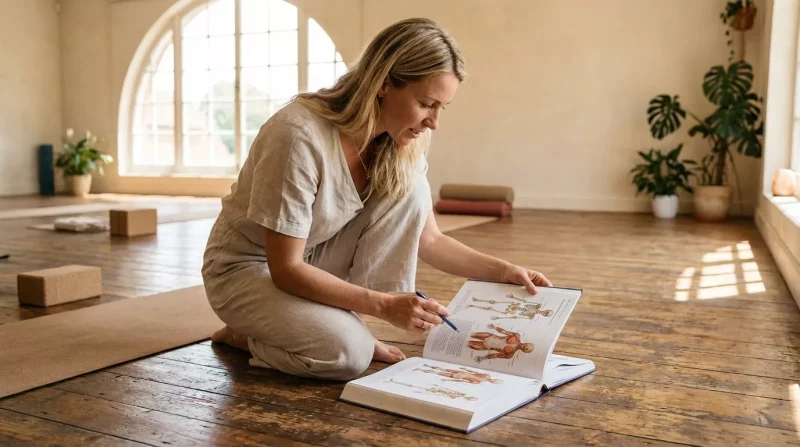
A sustainable yoga practice requires a grounded understanding of human anatomy.
Recognizing how the skeletal system, muscles, and connective tissues interact helps prevent injury and builds functional strength.
Yoga Anatomy by Leslie Kaminoff and Amy Matthews
This is arguably the best book for understanding the internal mechanics of yoga, particularly the relationship between breath mechanics and spinal movement.
Kaminoff moves away from a purely musculoskeletal view and integrates the respiratory system’s impact on posture.
-
Practical Application: This text completely shifts how practitioners experience breathing in poses. Understanding how the diaphragm interfaces with the pelvic floor helps students realize why deep belly breathing in twists is anatomically restricted, and why directing the breath into the lateral ribcage (costal breathing) creates more space and mobility.
-
Internal Link Suggestion: Explore our detailed breakdown of [Breath Mechanics and Pranayama Techniques].
The Key Poses of Yoga by Ray Long, MD
Written by an orthopedic surgeon, this book provides vivid, color-coded anatomical illustrations of what muscles are contracting (agonists) and which are stretching (antagonists) during specific poses.
-
Practical Application: We frequently reference Dr. Long’s work when helping students overcome plateaus. If a student struggles with a forward fold like Paschimottanasana, understanding the principle of reciprocal inhibition—engaging the quadriceps to signal the hamstrings to release—turns a frustrating struggle into a scientifically grounded practice technique.
Foundational Books for Meditation and Mindfulness
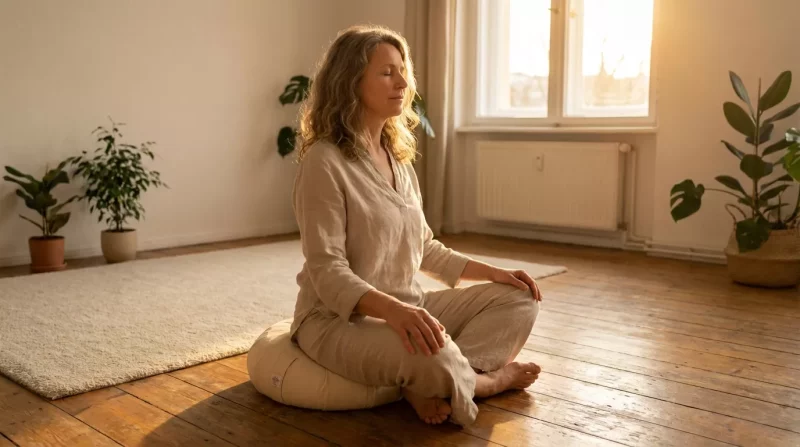
Meditation is the pinnacle of the yoga practice. The physical postures were traditionally designed to prepare the body to sit comfortably in meditation.
The best books on this topic make the internal landscape accessible and less intimidating.
The Miracle of Mindfulness by Thich Nhat Hanh
Written by the renowned Zen master, this book is a gentle, practical introduction to integrating mindfulness into mundane daily activities.
It strips away the esoteric language and focuses on pure presence.
-
Practical Application: Beginners often feel they are “failing” at meditation because they cannot stop their thoughts. We use Thich Nhat Hanh’s approach to teach that mindfulness is simply the act of noticing. Whether washing dishes or walking, anchoring attention to the breath helps down-regulate the sympathetic nervous system (fight or flight) and activate the parasympathetic state (rest and digest).
-
Internal Link Suggestion: Start your seated practice with our [Beginner’s Guide to Daily Meditation].
Wherever You Go, There You Are by Jon Kabat-Zinn
Kabat-Zinn, responsible for bringing Mindfulness-Based Stress Reduction (MBSR) to Western medicine, provides a non-sectarian look at mindfulness.
This book is perfect for those who want the physiological and psychological benefits of meditation without the religious or traditional dogmas.
-
Practical Application: This text is highly effective for practitioners dealing with physical pain or emotional stress. By teaching the concept of “non-judgmental awareness,” students learn to observe physical sensations in their asana practice—like the burning in their thighs during Warrior II—without immediately reacting or escaping the posture.
How to Apply Reading to Your Physical Practice
Reading about yoga is only the first step; the true wisdom is experiential. When you read a new anatomical cue or a philosophical concept, take it onto the mat immediately.
-
Test Alignment Cues: If a book suggests a new way to rotate your shoulders in Downward Dog, try it mindfully. Notice how it impacts your neck tension and breath capacity.
-
Integrate Breathwork: Apply the respiratory mechanics detailed in anatomy books to your morning pranayama. Notice the subtle movements of your ribcage and diaphragm.
-
Practice Self-Study (Svadhyaya): Use philosophy books as prompts for journaling or intention-setting before you begin your physical movement.
Conclusion and Next Steps
The “best” book on yoga and meditation is the one that meets you where you are right now. If you are struggling with injuries, dive into Yoga Anatomy.
If you are seeking mental clarity, open The Miracle of Mindfulness. True progression in yoga requires a balance of self-study (Svadhyaya) and consistent, mindful physical practice.
If you want structured guidance in applying these philosophies and anatomical principles to your own body, translating theory into experiential learning is often easier with real-time feedback.
For practitioners who prefer learning under professional supervision, exploring our foundational classes or specialized workshops can help you safely integrate these concepts into your personal practice.
Would you like me to recommend specific reading materials tailored to your current level of experience or specific physical goals?