
You may be able to practice yoga on carpet, but the carpet, your mat, and the movements all affect how stable the setup feels. A low, firm carpet is different from thick, soft pile. Neither the word “carpet” nor a mat placed on top guarantees a suitable surface.
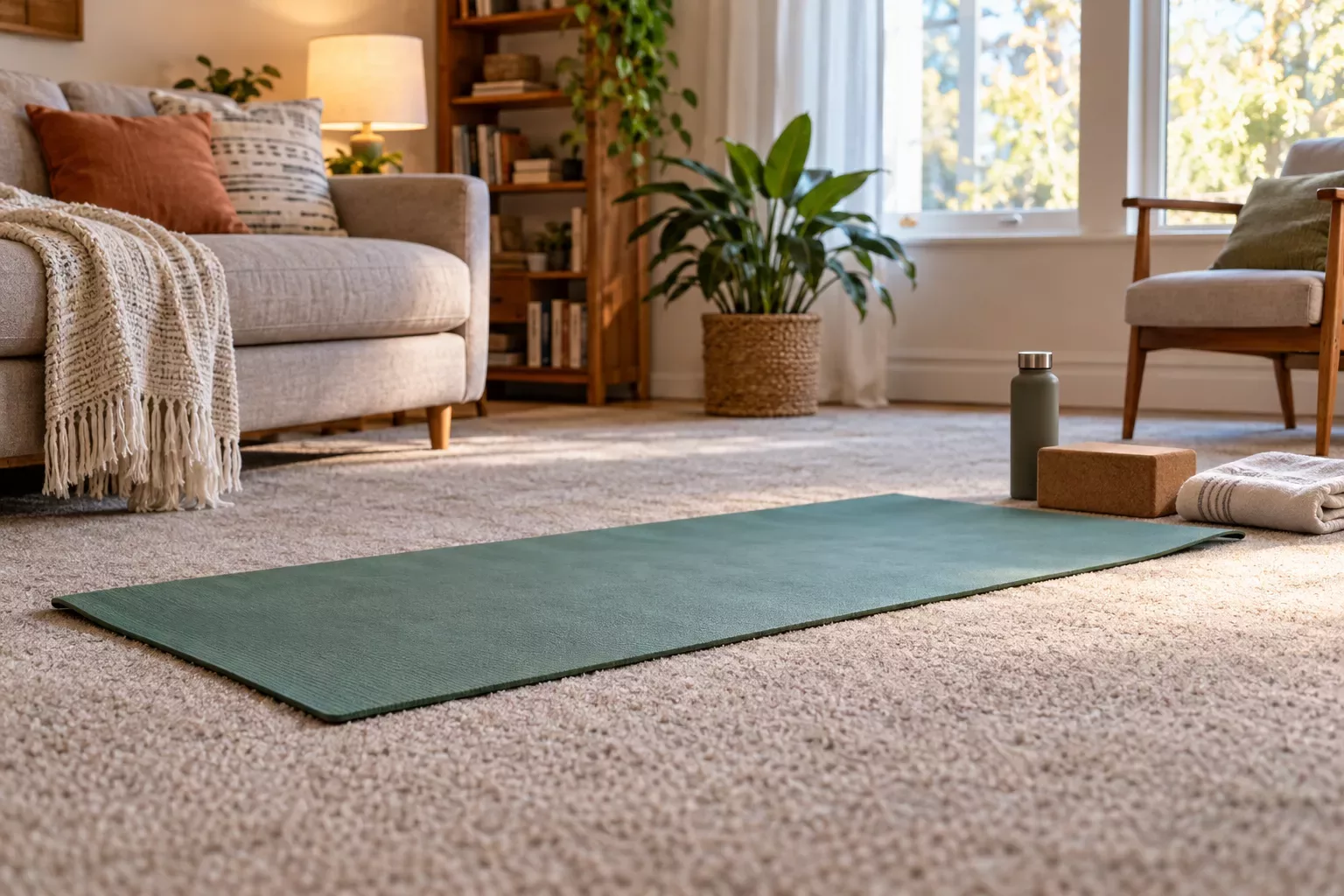
For a beginner, the priority is a predictable base. If your feet or mat keep moving unexpectedly, change the setup rather than trying to compensate with a harder workout.
Separate the three possible problems
First, look at what is moving. Your hands or feet can slide on the mat's top surface. The entire mat can creep over the carpet. Or the carpet and mat can compress enough to feel uneven under you.
These are different issues. Cleaning a slippery top surface will not necessarily fix a mat that bunches underneath. Adding more soft cushioning can also leave the base feeling less stable.
Check the setup before playing a class
Clear the area and place the mat flat. Inspect for folds, curled corners, or anything trapped underneath. Stand normally and make a small, controlled weight shift. Keep the test simple; do not use a challenging pose to find out whether the floor works.
If the mat creases, travels, or feels unsteady, stop the test. Try a firmer area of the home if one is available. A different location is a valid answer even when you would prefer to use the carpeted room.
Match the practice to the surface
A class with repeated steps and transitions puts different demands on the base than a seated lesson. Preview the sequence and consider whether the floor supports it. If balance is uncertain, do not assume that choosing a “beginner” video solves the surface issue.
Avoid using a loose towel as a general-purpose fix under your feet. Do not place an unsecured board over carpet to create a makeshift platform. Any added layer introduces another surface that can move.
Keep grip and cushioning separate
It is understandable to want softness, especially when learning floor positions. Yet more cushioning is not the same as more stability. The right decision depends on what you are doing and what feels controlled.
Before buying anything, check the mat manufacturer's surface and care guidance. If the existing setup does not work, ask a qualified instructor about a suitable practice location or a different style of session.
Know when to change the plan
Choose another surface or class when you repeatedly lose traction, the mat will not lie flat, or you cannot move without worrying about the base. Skip positions that are uncomfortable instead of padding over every problem.
You do not need to prove that carpet can work. You need a setup that works for you and your chosen session. Make that decision before starting, so the practice can focus on learning rather than managing a moving mat.
Diagnose the surface problem before choosing a fix
The entire mat moves
Watch the edges rather than your hands. If the whole mat travels across the room, the issue concerns its relationship with the carpet below. Adding a towel on top addresses a different surface and may introduce another moving layer.
Stop the practice and reset before trying another ordinary weight shift. If the movement continues, change location or seek a more suitable setup. Do not keep practicing with a plan to pull the mat back into position between poses.
The mat develops folds or ridges
Bunching is different from a mat sliding as a flat sheet. A crease can change the surface beneath a hand or foot unexpectedly. Flatten it and inspect the arrangement before continuing.
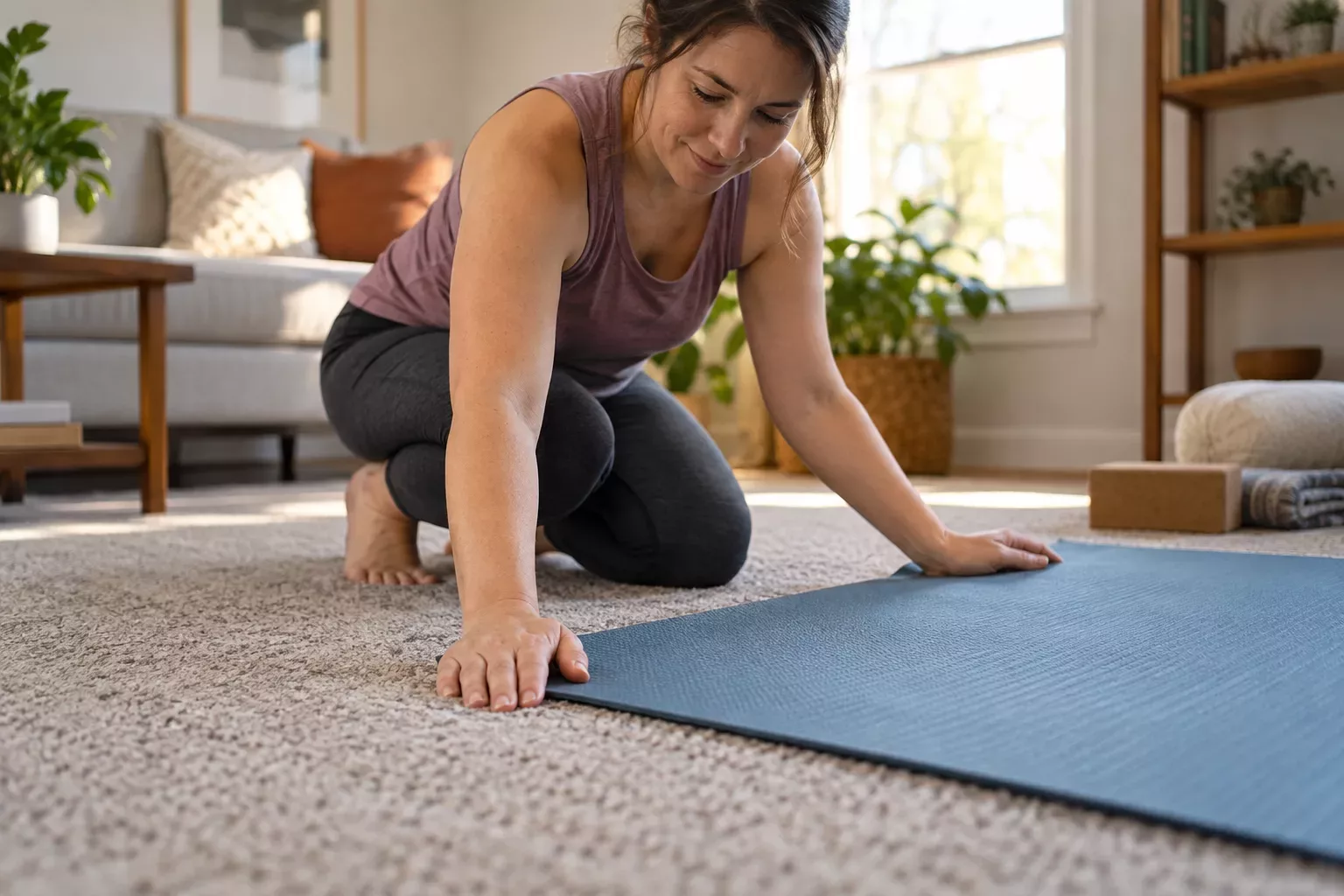
Consider whether the carpet is soft enough to let the mat distort. Do not assume that securing the corners will solve what happens in the middle. Avoid using improvised fasteners or loose objects that can become obstacles.
Your hands or feet slide on top
The carpet may not be the only contributor. Check the mat's top surface and the manufacturer's care instructions. Moisture, cleaning residue, or wear may affect the experience, but do not diagnose the material from one movement alone.
If the top does not provide predictable traction, stop using the setup for the planned activity. A small routine is not automatically suitable just because it involves fewer movements. You still need confidence in the base.
A worked comparison: living room versus hallway
Suppose the living room has thick carpet and enough area for the class, while a hallway has firm flooring but little sideways clearance. Neither choice automatically wins. You first preview the lesson and discover it includes wide steps. The hallway does not fit, and the living-room mat feels unstable during a simple standing check.
The practical answer may be a different lesson in a third area, or a suitable seated format. You do not have to make either unsuitable room work by reducing every movement yourself. The example illustrates a decision process, not a claim about which flooring every reader should choose.
Before buying anything, record the problem precisely: whole mat movement, top-surface slip, or compression and unevenness. That description gives a teacher or manufacturer something specific to respond to. “I need a better mat” is a less informative starting point.
A carpet-practice troubleshooting table
| Observation | Do not assume | Useful next action |
|---|---|---|
| Mat creeps forward | A top towel will fix the underside | Stop, reset, and reassess mat-to-floor stability |
| Center bunches | Flat corners prove the mat is stable | Inspect the entire surface and change setup if needed |
| Hands slide | Carpet is necessarily the cause | Review top-surface care and traction separately |
| Base feels soft | More softness will improve control | Compare a firmer appropriate location |
| Footing changes during turns | Familiar poses remain predictable | Stop and reassess the planned transitions |
| One class fits, another does not | One successful session proves all classes fit | Preview each new class's demands |
Keep household solutions proportionate
Do not stack random nonslip products, folded towels, and boards until a surface appears usable. Each additional layer adds a relationship you need to assess. A product intended to hold a household rug is not automatically suitable beneath an exercise mat during dynamic movement.
If a manufacturer recommends a particular surface arrangement, follow the actual instructions and limitations. Do not extend the recommendation to deep pile or a different mat material without checking. A marketing phrase such as “nonslip” is not a guarantee for every room.
Change the practice before forcing the floor
Sometimes an appropriate seated class or a lesson elsewhere will serve the immediate need better than another equipment purchase. Choose that option deliberately. It is not a lesser result if it helps you learn without managing a moving base.
If you need individual support because of balance, joint symptoms, or another condition, a general flooring guide cannot choose the right exercise surface for you. Bring the relevant details to an appropriate professional or instructor.
Keep the decision tied to the intended movement
Recheck after changing one part of the setup
If you change the mat, move to a different part of the room, or use another class, reassess the base with simple ordinary movements before proceeding. A change that improves one observation does not establish that every issue has disappeared. For example, a mat may remain flat while the underlying carpet still feels uneven during an uncomplicated weight shift.
Record what changed and what you observed. The purpose is a small troubleshooting note, not a homemade product test claiming universal results. Product materials and individual needs vary. Your observation can help you explain the problem to a teacher or manufacturer, but it does not prove that the same setup is right for another person.
Keep a practical alternative ready
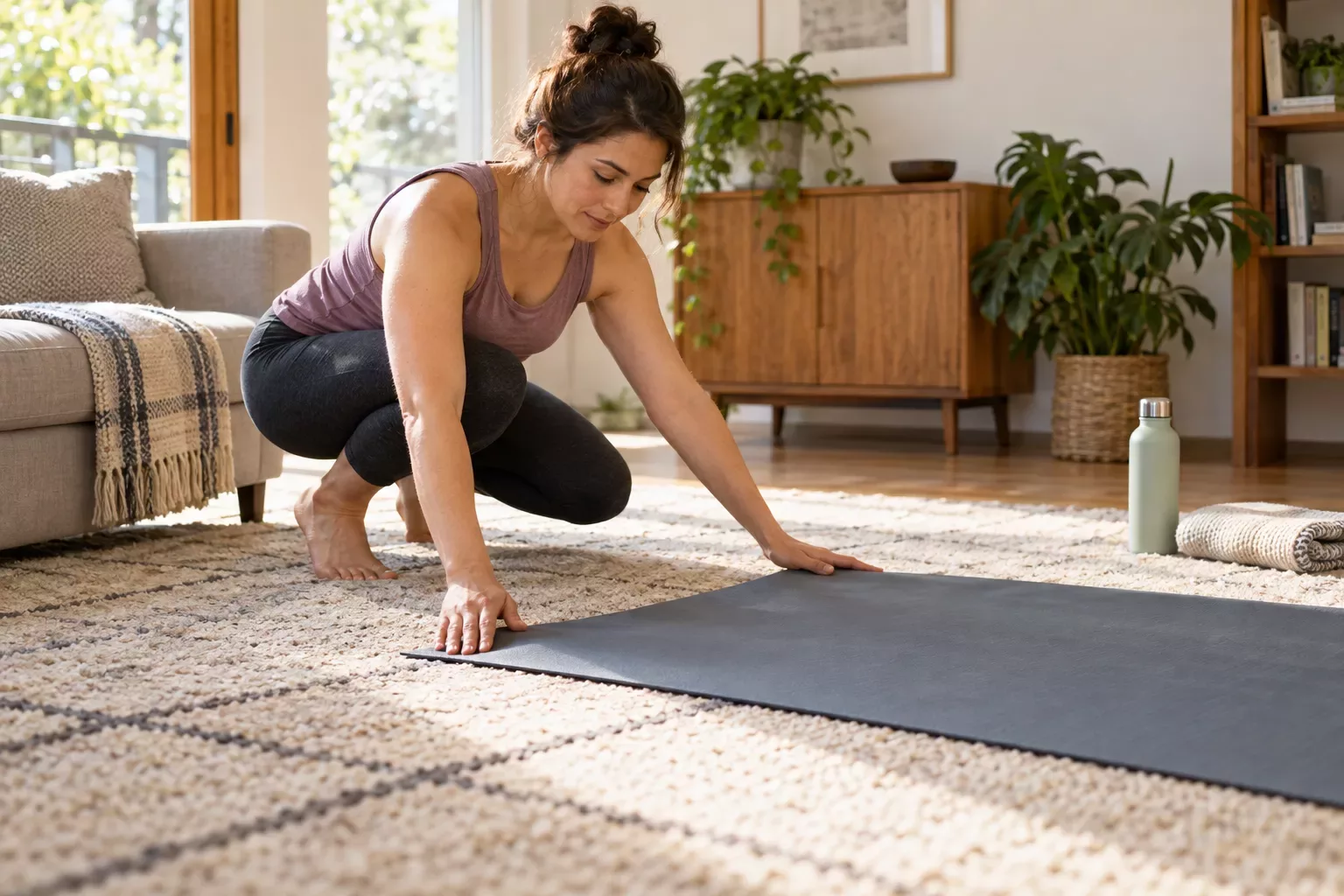
If the carpeted area cannot provide a predictable base, decide what you will do instead before starting the class. You might use an appropriate stable seated option, choose a suitable lesson in another room, or use the time to arrange instruction. That avoids the pressure to continue because the video has already begun.
A useful home practice does not depend on proving a particular floor can work. It depends on matching the movement, environment, and instruction. When those parts do not fit together, changing the plan is a reasonable outcome of the assessment. You can return to the flooring question when you have better information, rather than adding improvised layers until the original plan appears possible.
Continue learning
- How Much Space Do You Need for Yoga at Home? A Small-Room Checklist
- How to Start Yoga at Home When You're a Complete Beginner
Questions and answers
Does thick carpet mean I can skip the mat?
Not automatically. Carpet softness does not establish grip, support, hygiene, or suitability for a particular movement. Check the actual class and the surface under the parts of your body involved. A mat also does not guarantee a solution when placed on top. If you cannot create predictable footing and support, select another location or an appropriate practice format instead.
Is a thicker yoga mat always better on carpet?
No. Thickness alone does not tell you how the combined surface will behave. Material, firmness, the carpet, and the movement all matter. Extra softness may leave the base feeling less predictable. Describe the problem before shopping, consult product-specific guidance, and avoid treating a single thickness recommendation as suitable for every carpet or every beginner.
Can I use a household rug pad under the mat?
Only consider an arrangement that is appropriate for the products and the intended activity, and do not assume a rug pad is designed for exercise. It may change one kind of movement while adding another layer to assess. If the mat still creeps, bunches, or feels uneven, stop using that setup. Another surface or class may be the simpler choice.
What if the carpet is the only floor available?
You still do not have to force an unsuitable floor session. Ask about a suitable seated or standing option that fits the available environment, or use the time to learn and arrange appropriate instruction elsewhere. The goal is an understandable practice with a predictable base. Completing the planned video is not more important than resolving the setup problem.
Should I keep using the carpet if the problem appears only during turns?
Treat the turn as part of the class's requirements rather than ignoring it because the starting position felt stable. Pause and identify whether the mat moved, folded, or felt uneven, without repeatedly attempting the troublesome transition as a test. A setup that works for one position may not fit the whole sequence. Choose another appropriate location or lesson, and ask for guidance when you cannot determine a suitable alternative. The aim is predictable support throughout the planned activity.
What information helps when contacting the mat manufacturer?
Provide the mat model, the type of carpet if known, the layers underneath, and a plain description of what happens. Distinguish a flat mat creeping across the carpet from its center bunching or your hands sliding on top. Mention the care products you have used and ask about the manufacturer's intended surfaces and limitations. Their product guidance can clarify use and care, but it does not assess your movement needs or establish that a particular yoga class fits you.