
Ten minutes can be enough for a focused introduction, a familiar practice segment, or a short break in your day. It is not a guarantee of particular fitness changes, and it does not automatically replace a broader activity routine.
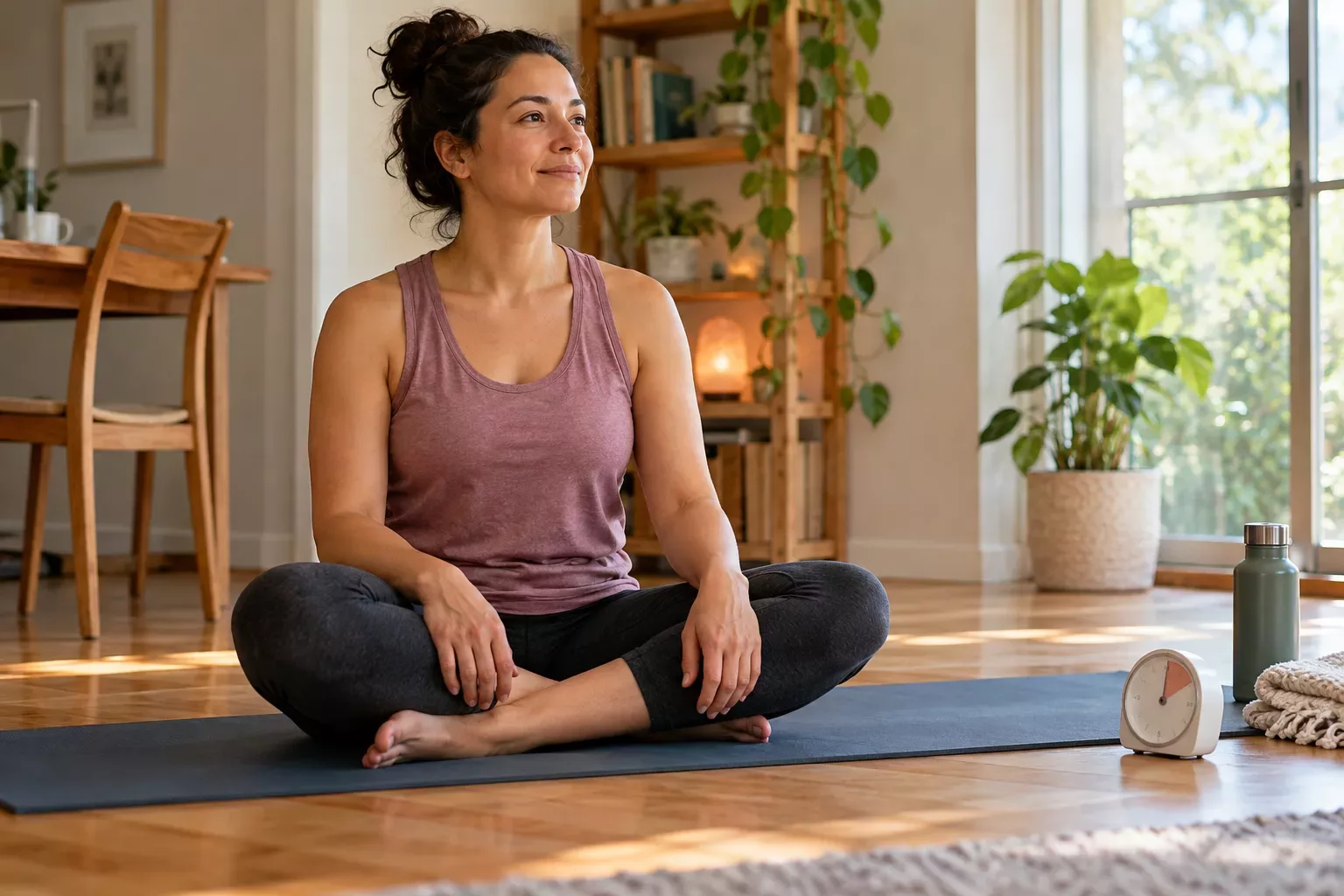
The useful question is: enough for what? Give the session one job, and a short amount of time becomes easier to use well.
Give enough a specific meaning
Ten minutes can serve several different purposes, but the purpose must be named. Enough to preview a beginner lesson is a different question from enough to meet an exercise goal. Enough to repeat a familiar section is different again. When the question stays vague, it invites oversized claims that a single short practice can accomplish everything.
Write the intended result in a sentence you could evaluate afterward. Examples include understand the starting position, practice a suitable familiar segment, or use a planned break for movement. These are modest aims with clear boundaries. They do not promise a treatment effect, a body change, or a complete fitness program from a particular runtime.
Separate immediate tasks from long-term goals
A long-term interest such as becoming more active can guide your choices without becoming the assignment for each session. The immediate task might be selecting and following an appropriate lesson. You can judge whether that happened today. The broader goal requires looking at your overall pattern and the actual activities it contains.
This distinction prevents a short session from feeling worthless because it cannot deliver an entire long-term result. It also prevents inflated promises. You can value a useful small task while acknowledging exactly what it did and did not establish.
Match the task to the time available
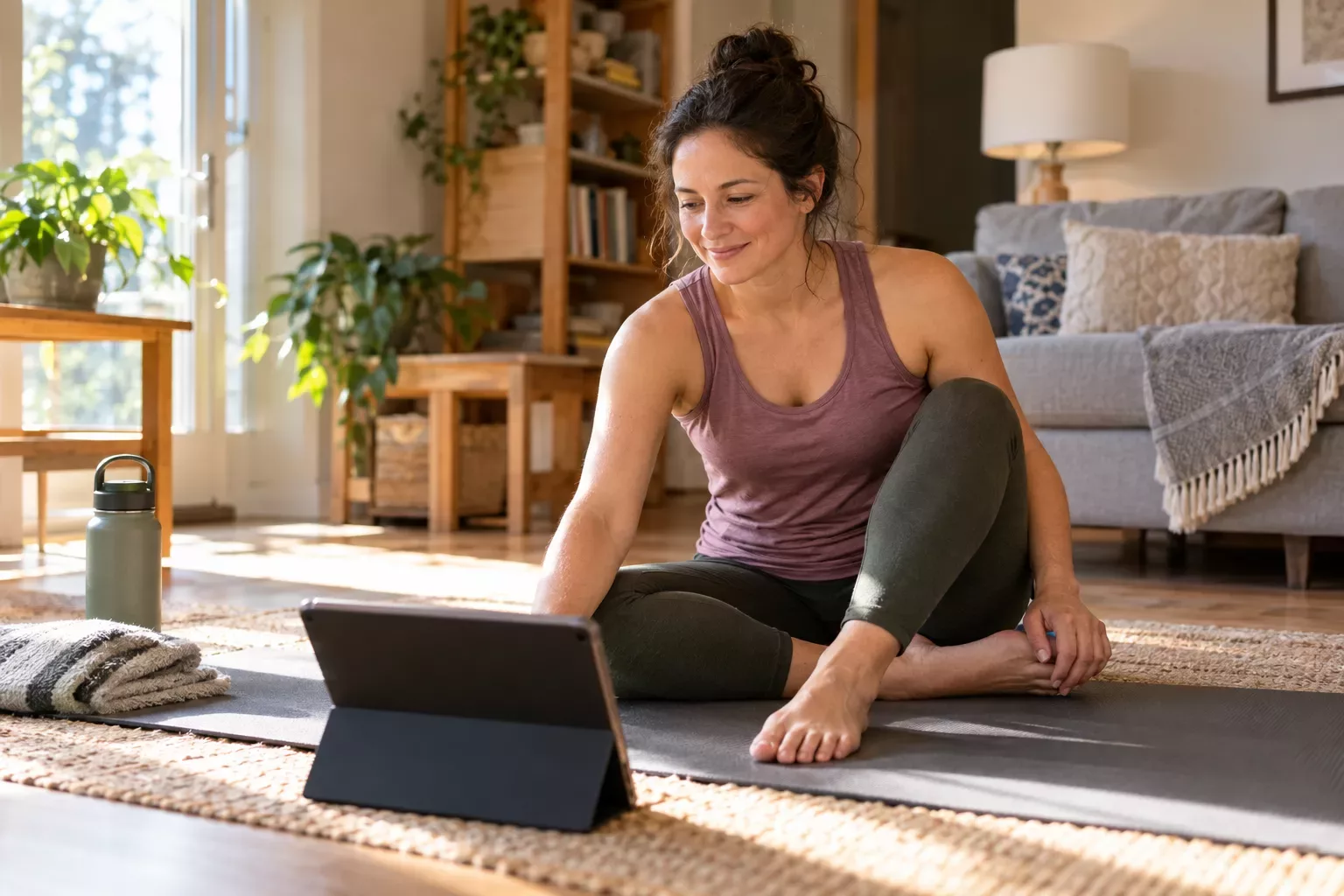
If you have ten minutes total, reserve some of that window for setup and finishing. The remaining time determines what recorded content fits. If the room and device are already prepared, you may use more of the window for the lesson. Do the arithmetic using your actual arrangement rather than the video title.
Avoid compressing content by skipping every explanation or speeding up unfamiliar transitions. That changes the learning task. If the planned lesson does not fit, choose less content or another opportunity. A short session has value when its purpose remains coherent, not when it contains the largest possible number of movements.
| Purpose | A useful short-session outcome | What the outcome does not prove |
|---|---|---|
| Learn a starting setup | You can describe it and ask remaining questions | Every position in the full class fits |
| Repeat familiar content | You followed the selected segment appropriately | You need a harder class next |
| Try a new teacher | You can judge the clarity of their cues | Their entire library suits you |
| Use a movement break | You deliberately changed activity | All daily activity needs are met |
| Prepare for later practice | You selected suitable instruction and space | Observation time equals exercise |
Understand why content matters more than the headline
The same ten minutes may include mostly explanation, continuous movement, or time arranging support. Those experiences cannot be evaluated by duration alone. Before asking whether the session was enough, describe what actually occurred. This keeps your expectations connected to the lesson rather than to an appealing number in the title.
CDC explains that adult activity planning includes different activity types and that aerobic demand depends on intensity. A short yoga recording is not automatically a substitute for all of them. CDC activity overview
Avoid treating effort as the only measure
A demanding session is not necessarily a better learning session. If your purpose is understanding an instruction, you may spend much of the window watching and asking questions. If your purpose is following a familiar appropriate class, you may not learn new vocabulary. Judge the task by the purpose selected, while continuing to make sensible choices about suitability.
You also do not need to feel dramatically different at the end for the planned task to have happened. A short practice can be ordinary. Avoid assigning a guaranteed emotional result to each attempt or extending it simply because you expected a stronger sensation.
Choose complete short lessons carefully
A short recording designed as a whole lesson may be easier to use than an arbitrary excerpt of a longer class. Its opening and finish are visible, and you can preview its requirements together. This does not guarantee suitability, but it gives you a clearer object to evaluate.
If you use a section of a longer recording, understand what the teacher assumes came before it. A middle segment may depend on preparation or instruction you have not seen. Ask for guidance when you are unsure how to use it. Do not assume that any ten-minute slice becomes a self-contained beginner practice.
Keep a clear endpoint
Choose how the session will end before starting. Leave time to return to an appropriate comfortable position, put away the device, and restore the room. An abrupt sprint to the next appointment undermines the reason for choosing a manageable window. If the endpoint keeps disappearing, reduce the content rather than removing the finish.
Turn off autoplay or close the platform when you have completed the selected task. Another recommendation is not a reason to extend the session. You can explore new lessons later, when choosing content is itself the planned activity.
A hypothetical ten-minute decision
Imagine Owen has ten minutes before a work-from-home meeting. His room still needs clearing, so a recording labeled ten minutes would not fit the whole opening. He instead uses a shorter suitable lesson he has already evaluated, leaving space to prepare and return to work. On another day, he uses a similar opening to preview an unfamiliar transition without attempting it.
Owen records these as different tasks: physical practice on the first occasion and lesson preparation on the second. Both may support his broader plan, but he does not treat them as equivalent exercise. This fictional example illustrates honest purpose and time accounting rather than prescribing a particular movement break.
If Owen wants longer sessions later, he can reserve a larger window and select content that fits it. He does not have to lengthen the next session merely to compensate for choosing a short one today. Duration changes should serve a reason, rather than a rule that small sessions are inherently inadequate.
Review what the session actually achieved
Afterward, ask whether the selected task was clear, the content fit, and the finish worked. If the answer is no, identify which part needs changing. Too much searching suggests preparation; unclear cues suggest instruction; an overly broad goal suggests reducing the task. These responses are more useful than declaring all short yoga ineffective.
Keep broader goals in a separate review. Your whole week's activity, learning, and practical opportunities provide more context than a single ten-minute attempt. A short session can have a meaningful role without being asked to represent the entire plan.
Continue learning
- How to Start Yoga at Home When You're a Complete Beginner
- How Often Should Beginners Do Yoga at Home?
- How to Build a Yoga Habit at Home: 11 Practical Steps
What ten minutes does, and does not, tell you about results
Runtime is an input, not a result. Ten minutes tells you how much time a recording occupies. It does not identify how active you were, what you learned, or whether that class fits a health or fitness goal. When someone says ten minutes is enough, ask what outcome they mean and what evidence supports that particular claim.
| Question | What you can check today | What needs more information |
|---|---|---|
| Did I learn this setup? | Explain the starting arrangement and identify any remaining question | Whether the rest of the class is appropriate |
| Did I use my planned window? | Record preparation, lesson, and finishing time separately | Whether a different day or duration would fit better |
| Does this meet my weekly activity needs? | Describe the actual activity rather than its yoga label | The rest of your weekly activity, its intensity, and individual circumstances |
| Will this change sleep, pain, strength, or weight? | Record observations without declaring a cause | Evidence about that outcome, the studied program, and personal assessment where needed |
U.S. physical-activity guidance no longer requires activity to occur in bouts of at least ten minutes. That removes a minimum-bout rule; it does not establish that any ten-minute yoga video produces a particular health result. Read the federal guidance explanation. Do not turn the permission to start small into a guarantee about an untested routine.
Make a short-lesson selection card
Before pressing play, save the title, teacher, runtime, and link. Under that, answer four questions: Is this a complete short lesson or an excerpt? What starting position and transitions does it require? Does it include explanations I can understand? Where is its planned ending? These details help you choose a coherent task instead of an arbitrary slice of a longer class.
Add one sentence beginning “Today I want to…” and make the ending observable. “Understand the starting setup” gives you a question to answer afterward. “Transform my health” does not tell you what to do with this recording. If your goal needs individual advice, the card can hold your question for a teacher or health professional rather than pretending the video has answered it.
Two examples with the same clock time
Alex has ten minutes total before leaving home and still needs to clear the room. The workable choice might be a shorter complete lesson or a preview task, not a ten-minute recording followed by a rushed exit. Jordan has already prepared the room and has a separate buffer afterward; a suitable ten-minute lesson may fit that arrangement. These fictional examples describe logistics, not equivalent physical demands.
Keep the card for the next attempt. If the arrangement worked, you can reuse the information rather than searching again. If it did not, change the field connected to the problem: the window, the recording, the setup, or the unresolved question. You do not need to extend the duration simply because you have completed the card once.
Questions and answers
Does ten minutes count if I cannot finish the video?
Describe what you did rather than treating the recording as a pass-or-fail test. You may have completed a useful segment or discovered that the lesson is unsuitable. If the video consistently exceeds your window, select shorter appropriate content instead of rushing to reach its ending.
Is a short class always easier than a long one?
No. Short classes can move quickly or assume substantial familiarity. Preview pace, effort, transitions, and prerequisites. A longer instructional lesson may contain more explanation, while a short flow may contain continuous demanding movement. Runtime alone cannot tell you which one fits.
Can I split a longer class into short sections?
Only after understanding how the class is structured and what each section assumes. An arbitrary excerpt may omit important setup or instruction. A purpose-built short lesson can be simpler to evaluate. Ask an instructor how to divide content when you are uncertain.
Should I make every short session intense?
Intensity should not be added simply to justify limited time. Choose content appropriate to your situation and purpose. A learning session may be valuable without substantial effort. If you want an individualized exercise plan, seek guidance that considers the whole program rather than maximizing each small window.
How can I tell whether the session was useful?
Compare it with the specific task you chose. Did you understand the setup, follow familiar appropriate content, or identify a question to clarify? Practical observations give you a basis for the next choice. A dramatic mood change or a new flexibility measurement is not required to document learning.
When does a longer session make sense?
Consider a larger window when you have a clear purpose that needs it, suitable content, and time for the full arrangement. Longer is not automatically better. Keep duration connected to what you want to learn or practice and to the rest of your activity and responsibilities.