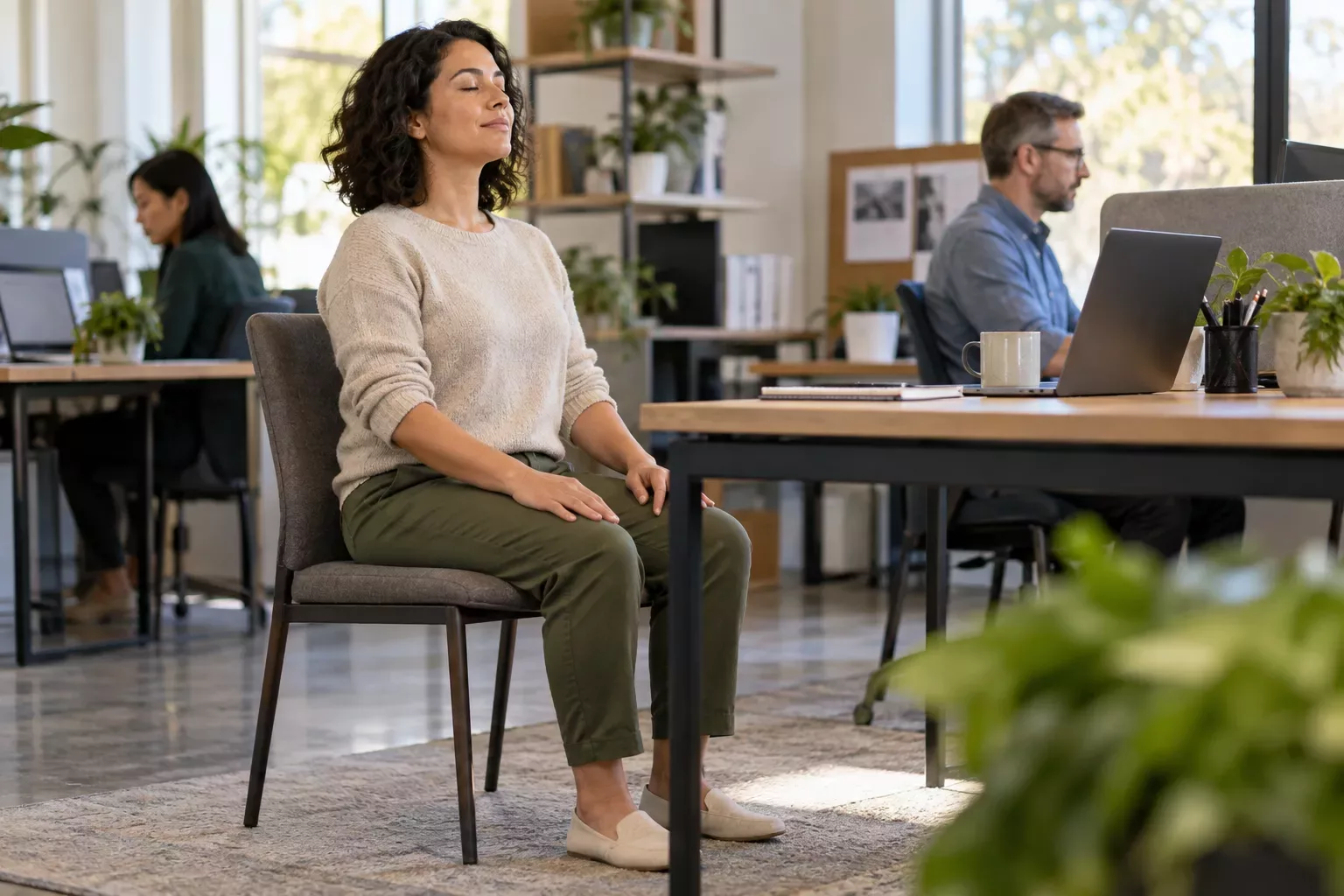
This guide answers whether a particular office chair fits the demands of a lesson. It does not rank chairs to buy or provide a separate yoga routine; check the equipment first, then choose suitable instruction.
An office chair is designed for workstation use, but it may not be suitable for a movement class. Wheels, swiveling, armrests, seat height, and a reclining back can change how stable it feels when you move away from a typing position.

The simplest starting point is a solid, stable chair without wheels. If that is not available, choose a break that does not depend on using the office chair as exercise equipment.
Wheels and swiveling change the decision
Do not assume a chair will stay put because it feels stable during normal typing. A reach or shift in position can move it differently. Placing it against a wall may not prevent every swivel or sideways movement.
Avoid standing poses that use a rolling chair for support. A chair that travels as you lean on it is not the same as a fixed support demonstrated by an instructor.
Check seat height and foot support
You should be able to sit without having to perch or let the feet dangle. If your feet do not reach a stable support, choose a different chair or activity rather than leaning forward to compensate.
Do not stack unstable objects under your feet. Keep the area clear enough that you can enter and leave the seat normally.
Look at armrests and the backrest
Armrests may obstruct a movement that looks easy in an armless chair. A reclining back may also shift when you expect firm support. Preview the class to see whether it asks you to use or pull against these parts.
Do not adapt a movement by grabbing a different piece of furniture without instruction. Change the class or the chair instead.
Separate the exercise setup from the typing setup
You may need to move away from the desk for a suitable seated session. That does not mean you should keep the same position when you return to computer work.
After the break, reset the workstation so the keyboard, screen, and chair work together. OSHA's workstation evaluation checklist provides a broader way to examine the desk environment.
Do not buy a chair before checking the class
Some chair-yoga lessons stay seated. Others include standing balances, side-facing positions, or movements around the chair. Choose the session first and understand the requirements before assuming one chair will suit all of them.
For simple seated exercise guidance, the NHS recommends a stable chair without wheels and notes that arms can restrict movement. Sitting exercises
If the available chair is a poor match, a normal walking break, a suitable standing session, or another change of task may be a more practical choice. You do not need to turn every office chair into a yoga prop.
Inspect the chair before you inspect the poses
Begin with the object you actually have, rather than the chair pictured in a class thumbnail. Look for damaged legs, loose connections, a shifting seat, or upholstery that slides as you sit. A chair can appear substantial and still move unexpectedly. If anything needs repair, take it out of your practice plan. Testing a damaged chair through progressively larger movements is not a useful way to establish safety.
Check the floor as well. A solid chair on an uneven surface is a different setup from the same chair on a flat floor. A rug can bunch beneath its legs, and a chair leg may catch on a rug edge when you sit down. Clear bags and cords from the approach so entering and leaving the chair do not require a sideways maneuver. Keep the ordinary route back to your desk open.
Distinguish adjustments from improvised restraints
An adjustable chair may have a manufacturer-provided control for its normal reclining or height mechanism. Understanding that control is part of using the chair as intended. Tying a rolling chair to a desk, wedging objects beneath its wheels, or assuming a wall will prevent every kind of movement is a different proposition. Those improvised restraints do not turn the chair into the equipment shown by an instructor.
Read the class requirements before relocating furniture. If the lesson requires an armless, nonrolling chair, an ergonomic swivel chair remains a mismatch even if it is expensive and comfortable for computer work. The word ergonomic describes a relationship between equipment, person, and task; it is not a general approval for every activity performed on the equipment.
Match the seated position to the lesson
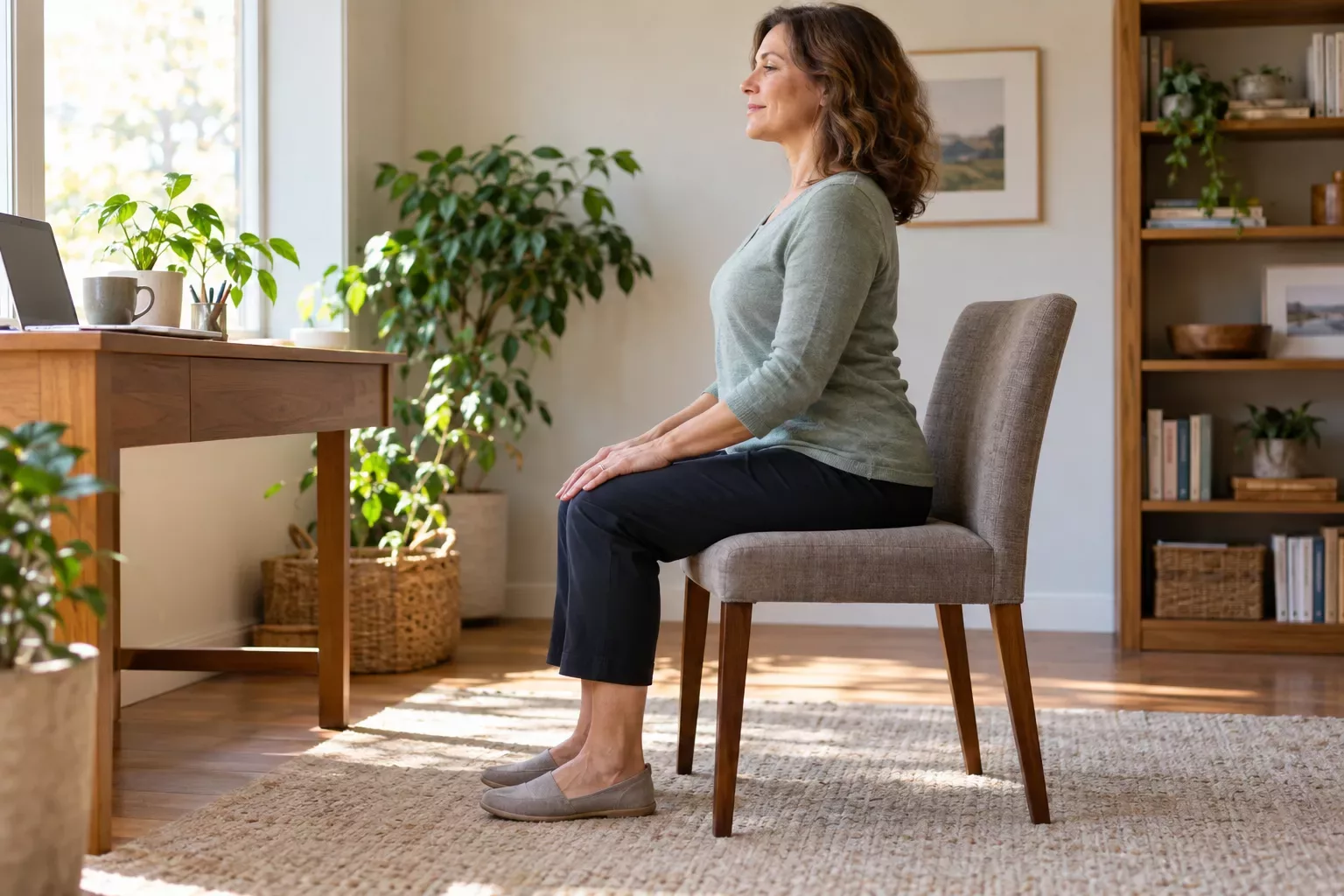
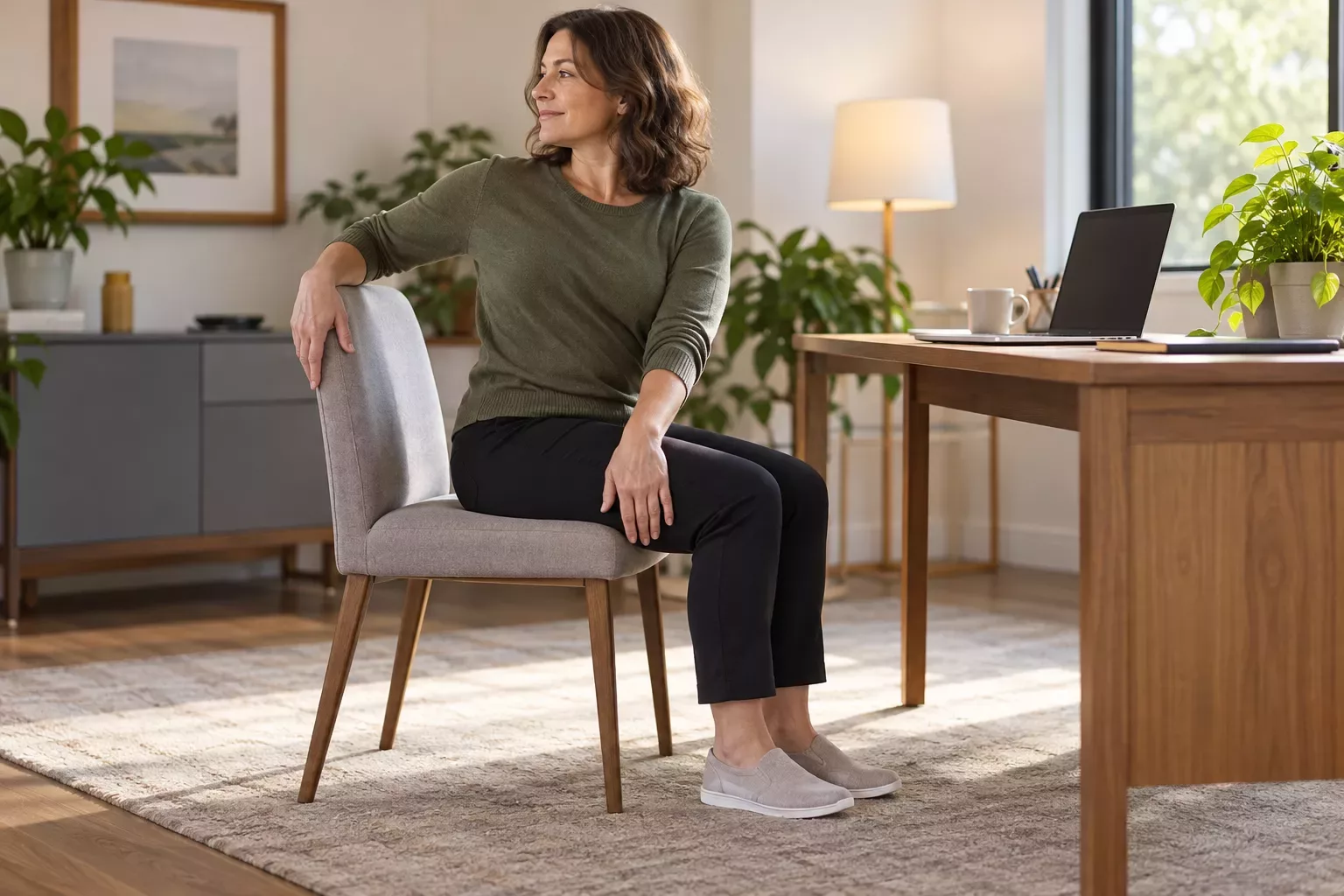
Some lessons use the backrest for ordinary support. Others ask participants to sit farther forward or face sideways. These are meaningfully different demands. Preview the opening position, transitions, and final movements rather than checking only whether the instructor begins seated. If a later portion stands behind the chair, evaluate that requirement separately. A suitable seat does not automatically make a suitable standing support.
For a hypothetical example, consider an employee who has a stable conference-room chair with arms. A lesson with small forward arm movements might fit the available clearance, while a lesson involving hands behind the backrest may not. The answer is to select an appropriate lesson or ask the instructor for an established option. Reaching around an obstructing armrest without understanding the movement adds a problem the original lesson did not address.
Check what happens when you stop moving
The resting position matters as much as the movement. You should have somewhere comfortable to place your hands and a way to keep your feet supported without holding constant muscular effort just to remain seated. If the chair is too tall, dangling feet are a reason to reconsider the setup. If it is too deep, you may find yourself sliding forward to reach the floor while losing the support you expected.
A purpose-made foot support used appropriately may suit ordinary workstation sitting, but do not assume every footrest fits every chair-yoga movement. A rocking footrest, narrow support, or loose stack of books can change the movement surface. Ask about the actual lesson requirements rather than adding height with whatever happens to be near the desk.
Use a simple equipment decision
| What you find | Practical next decision |
|---|---|
| Stable chair, clear floor, class stays within available support | Preview the movements and confirm they fit your needs. |
| Rolling or swiveling chair is the only seat | Choose another break format or find appropriate equipment. |
| Arms block a planned movement | Change the lesson or obtain a suitable chair. |
| Chair shifts, reclines unexpectedly, or needs repair | Stop the chair-based plan and address the equipment. |
| Lesson uses the chair for standing support | Assess that requirement separately with suitable instruction. |
Use this table as a decision aid, not a certification checklist. Passing a furniture check cannot establish that an exercise is suitable for an individual. Likewise, being comfortable with a movement does not excuse damaged equipment. There are two questions to answer: whether the setup is appropriate and whether the activity is appropriate for you.
Borrow thoughtfully before buying
If you are considering a separate chair for practice, first find out whether an appropriate existing chair is available. Ask before taking a meeting-room chair or moving shared furniture. Consider storage and the route between locations; a chair left beside a desk can create a new obstacle for someone else. A useful practice arrangement should include putting the equipment away.
When purchasing is necessary, use the requirements of a suitable lesson and the manufacturer's information to guide the choice. Avoid shopping by a vague label such as yoga chair alone. Check the actual design, dimensions, intended use, and any stated limitations. A folding design also needs evaluation: do not assume a folding chair is secure simply because many instructors use one of that general type.
Do a rehearsal without adding a workout
Before the workday session, rehearse the logistics: bring the chair into position, sit normally, place the screen, check the visible movement space, then restore the room. You do not need to perform the full class to discover that the door swings into the area or the screen is impossible to see. Fixing those practical issues ahead of time makes a short break easier to use.
Keep the rehearsal unambitious. It is not an invitation to test the chair's limits, lean on two legs, or pull hard against the backrest. If the class is unclear about a piece of equipment, seek clarification or choose a clearer class. Guessing how to secure furniture is unnecessary when another break activity is available.
Return to a separate computer-work setup
After practice, restore the chair you normally use for work and check its relationship to the keyboard, mouse, and screen. Do not continue typing from a temporary practice position merely because it is already arranged. A chair moved backward to create arm clearance may leave you reaching toward the desk afterward. A nonadjustable practice chair may also have a different seat height from your office chair.
Keep the wider workstation question separate from chair yoga. OSHA's chair guidance addresses fitting seating to computer tasks. That guidance helps explain why the office chair and practice chair can serve different jobs; it does not approve office furniture as exercise equipment. If work-related discomfort continues, examine the work arrangement and seek appropriate advice rather than adding chair exercises indefinitely.
Continue learning
- Chair Yoga at Work: A Beginner's Guide to Getting Started
- A 5-Minute Seated Desk Yoga Break for Beginners With a Printable Card
Questions and answers
Is a chair with locked wheels the same as a solid chair?
Not necessarily. Locking wheels may leave other movement, including swiveling, reclining, or shifting at the base. Follow the lesson's equipment requirements and the manufacturer's intended use. If the session calls for a nonrolling chair, choose one rather than treating a brake as a complete substitute.
Can I use the chair against a wall?
A wall may change one direction of travel without addressing other movement or the needs of the lesson. Do not use wall placement as a universal workaround for unsuitable equipment. A different chair, suitable standing option, or ordinary break is simpler when the available seat does not fit.
Does the chair need to be armless?
That depends on the class. Arms can obstruct side movements, hand placement, or transitions. They may be irrelevant to another seated lesson. Preview the entire session and select equipment that allows the demonstrated options without squeezing around furniture or changing a movement you do not understand.
Should I sit at the front edge for every chair-yoga movement?
No single seated position fits every lesson or person. Follow appropriate instruction and maintain the support you need. Do not perch automatically because a video uses that phrase. If the starting position feels unstable or difficult to maintain, stop and ask about another option.
Is buying a special chair necessary to start?
Often the first task is choosing a suitable lesson and checking whether appropriate equipment already exists. Avoid buying before understanding the requirements. If no suitable chair is available, you can select another break activity while deciding whether chair yoga belongs in your longer-term plan.
What if a movement hurts despite a stable chair?
Stop that movement. Stable furniture does not establish individual exercise suitability. Do not deepen the movement or continue to prove the equipment is working. Seek appropriate advice for persistent or concerning symptoms and use a different break option in the meantime.