
This short practice stays seated and uses small, unhurried movements. It is intended as a simple movement break, not a treatment for desk-related pain or a replacement for other activity. Use only movements that are appropriate for you, and stop if anything hurts or makes you feel unwell.

Set up a stable chair without wheels, keep your feet supported, and move far enough from the desk that your arms will not hit its edge. If your office chair cannot provide that setup, choose another break activity.
Minute 1: settle into the seat
Sit where you feel stable, with your feet supported and your hands resting comfortably. Let your shoulders settle without forcing them down. Look ahead rather than into your lap.
Breathe normally and notice whether anything needs changing: a tight waistband, an armrest in the way, or a bag under your feet. Use the whole minute for setup if necessary. It still serves the purpose of leaving the keyboard.
Minute 2: move the shoulders gently
Slowly lift the shoulders a little, then let them return to a comfortable resting position. Repeat a few times with pauses. Keep the movement easy and avoid turning it into a large neck circle.
Rest your hands on your thighs if that feels comfortable. If moving the shoulders is unsuitable, remain still and use the minute as a quiet pause.
Minute 3: explore a comfortable arm reach
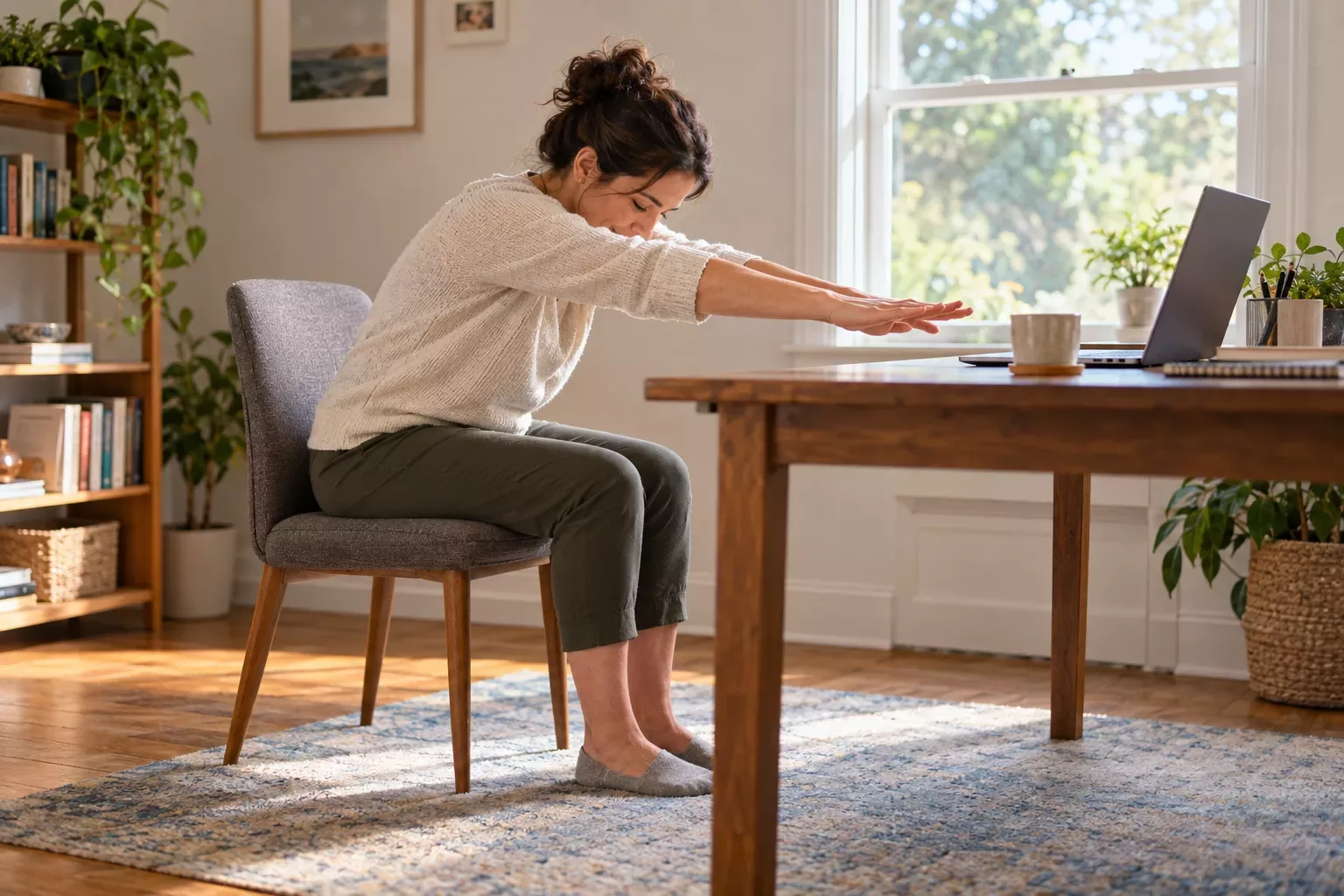
Slide one hand forward in the air at a height that feels easy, then return it. Try the other side. You can keep the movement below shoulder level and make it smaller.
Keep the torso supported and avoid leaning toward the screen or reaching beyond your control. There is no need to hold a deep stretch. Pause between sides and continue ordinary breathing.
Minute 4: make a small upper-body turn
If gentle rotation is appropriate for you, keep your feet planted and turn the upper body a small amount to one side, then return to center. Repeat on the other side. Do not pull on the chair to increase the range.
If twisting is restricted or uncomfortable, omit it. Stay facing forward and repeat an earlier comfortable movement instead. The alternative should feel deliberate, not like something you have to make up quickly.
Minute 5: return and finish
Let the arms rest. Notice whether you are ready to return to the task or would prefer an ordinary walking break if that is available. Take a moment before reaching for the mouse.
Adjust the chair back to your normal workstation setup. A position suitable for a short movement break may not be the position you use for typing.
Make the next break easier
Save the routine or keep a short reminder nearby: settle, shoulders, reach, optional turn, finish. Skip any part that does not suit your needs. For demonstrations of individual workplace movements, see Mayo Clinic's desk-stretch video collection.
You do not need to make each repetition bigger. Keep the break easy to understand, and vary your workday with other appropriate changes of activity when possible.
Understand how to use the five-minute outline
The minute labels organize a brief seated break; they are not a demand to move continuously for sixty seconds. You can spend part of a minute settling, listening, or resting. The outline is intentionally simple so you do not need to learn a complicated sequence beside the keyboard. Any movement still needs to be appropriate for your individual situation.
Keep the original order visible in a short note: settle, shoulders, reach, optional turn, finish. Read the descriptions before starting rather than trying to decipher them while moving. If you want a demonstration, choose appropriate introductory instruction and preview it separately. A written routine cannot observe you or confirm that an optional movement suits a restriction.
Include setup in the available window
If five minutes is the entire gap before your next responsibility, setup belongs inside those five minutes. Do not use the full period for movement and then hurry back to the workstation. A shorter practice with a deliberate finish is easier to manage than a complete sequence squeezed into a shrinking deadline.
Start only when the chair and space are appropriate. You should not be rolling away from the desk, untangling a headset cord, or closing drawers while the timer is already directing you to reach. If the setup is unavailable, choose another kind of break rather than turning preparation into an improvised exercise.
Troubleshoot the sequence without adding complexity
| What interrupts the routine | What to change next time | What to avoid |
|---|---|---|
| The chair moves unexpectedly | Use an appropriate stable seat or another break | Trying to hold a rolling chair in place while moving |
| The arm hits an armrest | Choose an appropriate smaller movement or different setup | Bending awkwardly around the obstruction |
| You forget the order | Keep the five-word reminder visible | Searching a long article while performing the movement |
| The next meeting begins early | End deliberately and reset the workstation | Rushing through remaining movements |
| A movement causes concern | Stop and obtain appropriate guidance | Repeating it to see whether more range solves it |
Use a flexible timer
A timer can provide a finish point, but loud alerts or constant countdown checking can become distracting. Choose a simple method that does not demand repeated interaction. If you cannot set it up without consuming the break, you can use the outline loosely and stop before your next commitment.
Do not restart the full routine because a notification interrupted one minute. Return to a comfortable resting position, decide whether to continue, and finish when the available time ends. This is a short workplace activity, not a sequence that loses its value if every segment is not completed perfectly.
A hypothetical adaptation for a short gap
Imagine Drew has five minutes between tasks, including the time needed to move to a suitable stable chair. Setup takes two minutes. Drew chooses a brief settling pause, the familiar shoulder movement if appropriate, and a clear finish, leaving out the optional turn. Drew then restores the workstation before the next task begins.
This is an invented timing example, not a claim that three minutes produces a particular result. It illustrates preserving the setup and finish when time is limited. Drew does not need to move faster, add repetitions later, or call the shortened break a failed routine.
Free printable card for the same seated break
Use this card after reading the full instructions above and learning any unfamiliar movement through suitable instruction. It is a memory aid for this routine, not a second routine or an assessment of individual needs. You may print or copy it for personal use without a purchase or email sign-up.
SEATED DESK BREAK – CHOOSE ONLY SUITABLE MOVEMENTS
| Part of the break | Reminder | Rest or adjustment option |
|---|---|---|
| Settle | Stable chair without wheels; feet supported; hands away from keyboard | Use the available time for setup or choose another break |
| Shoulders | Small, slow lift and comfortable return | Keep hands resting and remain still |
| Low reach | One arm moves gently forward and returns; then change sides | Keep it low and small, or omit it |
| Optional turn | Small upper-body turn only when appropriate; return between sides | Stay facing forward; do not pull on furniture |
| Finish | Arms rest; ordinary breathing; locate and restore the workstation | Finish before the next work responsibility |
Stop a movement that hurts or makes you feel unwell. There is no repetition target, and no requirement to complete every row.
Make a readable personal copy
Select this section in a document or use your browser's print preview to choose the page containing the card. Check that all columns, rest options, and the stop instruction remain together and readable. If the table clips at the margin, copy the same wording as a plain list. Keep the full instructions available for reference; shortening a reminder should not change its meaning.
Place the card where it can be read before the break without blocking the monitor or requiring a twist. One practical note, such as the location of a suitable stable chair, may help. Do not put private health details on a card visible to coworkers. Replace the copy when the chair, room, or your guidance changes rather than accumulating conflicting notes.
The card does not command a movement every time you see it. You may choose another appropriate break, and a quiet pause remains available when a listed movement does not suit the moment. Ordinary breathing here means just that; the card does not introduce breath holding or a timed breathing technique.
Keep the next break simple
Once you understand the outline, repeat the suitable parts rather than making every break more elaborate. If you want to learn additional movements, use a separate opportunity with clear instruction. Keep a note of any question that arose so you can ask an instructor instead of guessing through it during a busy workday.
The routine can coexist with other appropriate changes of activity. It does not remove the need to vary tasks or take opportunities to stand or walk when suitable. Choose the kind of break that fits the moment, and let the seated outline remain one option rather than a requirement for every pause.

Continue learning
- Chair Yoga at Work: A Beginner's Guide to Getting Started
- Can You Do Chair Yoga in an Office Chair? Check These Details First
Questions and answers
Do I have to move for the whole five minutes?
No. The outline includes setup, pauses, and a finish. You can spend a minute resting or omit a movement that does not suit you. The labels organize time; they do not prescribe uninterrupted activity or a number of repetitions you must complete.
Can I do the routine in less than five minutes?
You can shorten it while preserving a stable setup and deliberate finish. Choose fewer appropriate movements rather than rushing through all of them. If even the setup cannot fit, select another break activity instead of trying to perform the sequence while continuing to work.
Is the upper-body turn required?
It is optional. Omit it when restricted, uncomfortable, or unclear. You can remain still or use an earlier appropriate movement you already understand. Do not pull on the chair or substitute a larger twist because the timer indicates another minute is available.
What if my office chair has wheels?
The routine assumes an appropriate stable chair without wheels. Do not improvise by trying to keep a rolling chair still with your legs or furniture. Use a suitable seat in an appropriate area, or choose a different kind of break when that setup is unavailable.
Can I follow a work call while doing the movements?
Use a moment when you can give the activity your attention. A call may require listening, speaking, or an immediate response, and that can compete with unfamiliar instructions. Keep the movement break separate or choose a simpler pause appropriate to the work task.
How do I print the card without losing the important options?
Use print preview to select the card section and check that the rest choices and stop instruction remain on the copy. If the table is clipped, copy the same wording into a plain list. Keep the full movement descriptions available and use the shorthand only for actions you already understand. The card is a personal reminder, not a substitute for suitable instruction.