
You can look for an appropriate beginner yoga class without first becoming flexible. Reaching a particular position is not an entrance requirement. What matters is choosing instruction and movement options that fit the body you have today.
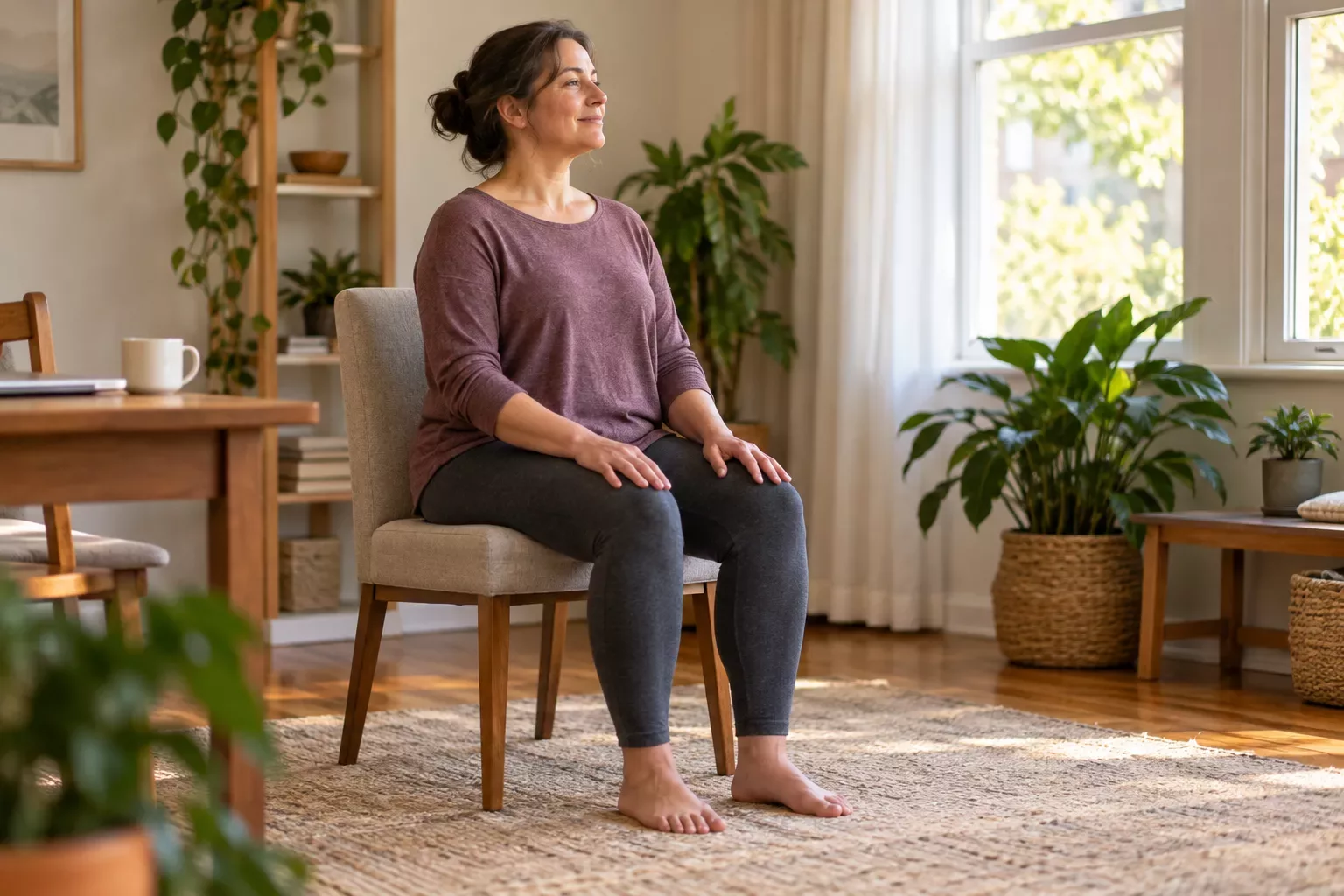
If a class repeatedly asks you to force your way into shapes you cannot manage, change the class or seek individual guidance. You do not need to “earn” a beginner lesson by touching your toes.
Replace the picture with the purpose
In a video, you see the teacher's finished shape. You do not see everything about their proportions, experience, or individual range of movement. Copying the outline exactly may be an unhelpful goal.
Instead, listen for the setup and the intended action. Ask whether a smaller range, a different starting position, or an alternative exercise is offered. A teacher who explains options gives you more to learn than a demonstration alone.
Tell the teacher what happens
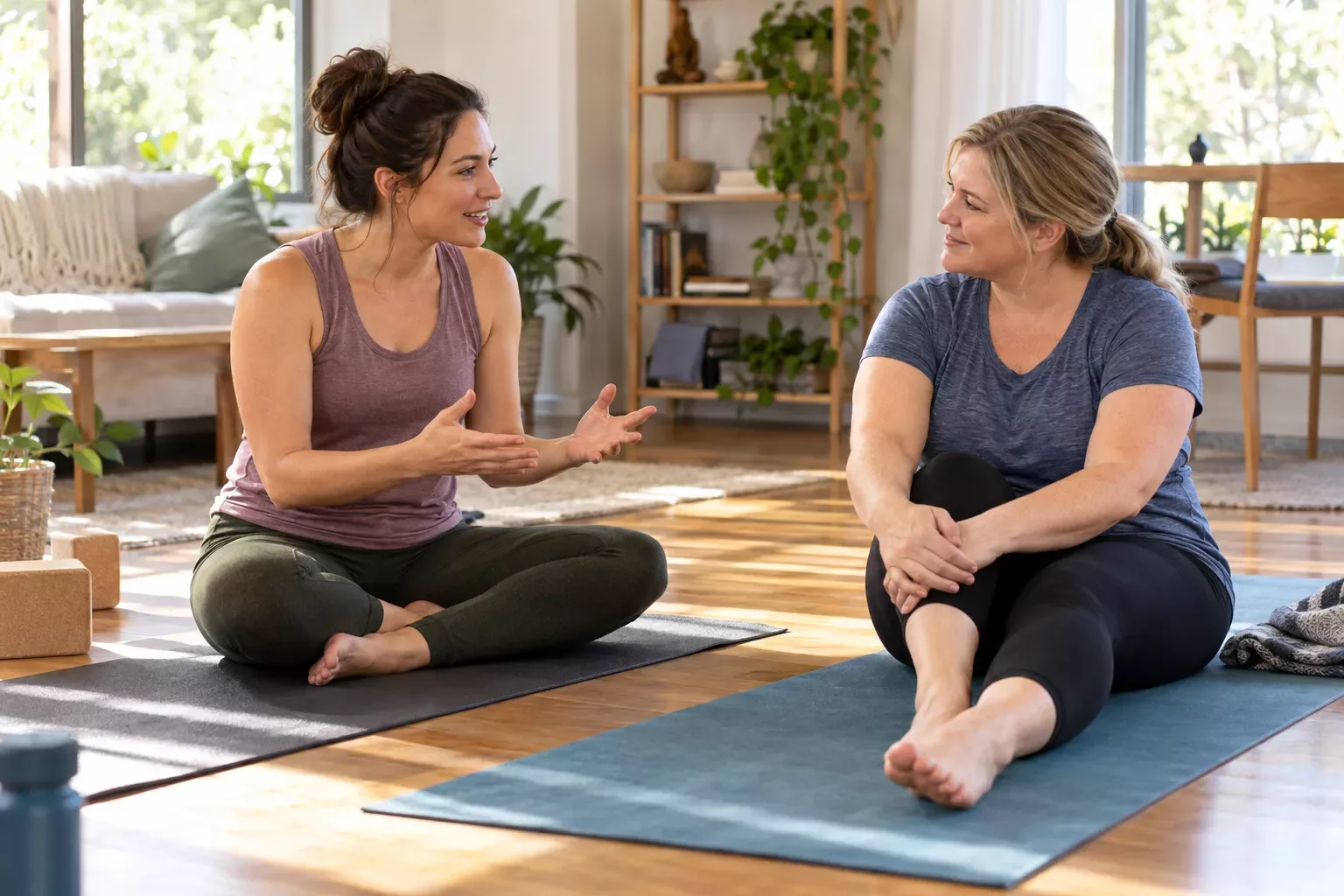
If you attend a live class, be specific. “I cannot sit comfortably cross-legged” gives the teacher a practical problem to address. “I am terrible at flexibility” is a judgment that does not describe what you need.
You might need a chair for the seated portions or a class that avoids certain transitions. Do not assume that a prop solves every limitation. Ask how to use it and whether the suggested movement is appropriate.
Avoid testing yourself every session
Repeatedly checking how far you can reach can distract from learning. Choose another measure: can you follow the cue, move with control, and return from the position comfortably?
A smaller movement done deliberately is useful information. A deeper movement achieved by pulling, bouncing, or holding your breath does not prove that the session is going well.
Keep expectations realistic
People respond differently to practice. Your schedule, previous activity, individual anatomy, and the kind of class you choose all matter. Avoid programs promising a specific pose or flexibility milestone by a fixed date.
General stretching guidance emphasizes controlled movement rather than painful effort. The American Heart Association provides an overview of flexibility exercise; your instructor can help connect general principles to a suitable yoga lesson.
Choose an achievable first step
Preview a complete-beginner class and find out whether its seated and standing positions work for you. If they do not, try a seated or standing-only format instead of improvising through a difficult sequence.
After the first session, record one adjustment that helped. Perhaps you needed a different seat, less range, or more time to transition. That is progress in understanding how to practice.
Flexibility may be one reason you are interested in yoga, but it does not have to become a test you take before every class. Begin with appropriate instruction and make the practice something you can learn from, rather than a picture you must reproduce.
Describe your starting point without labeling your body
Not flexible can mean several different things. You may find sitting on the floor awkward, be unfamiliar with reaching movements, or compare yourself with a teacher whose proportions differ from yours. Start by naming what actually happens. A concrete description gives you a better basis for choosing instruction than a broad judgment that your body is unsuitable for yoga.
For example, write I cannot comfortably maintain that seated position rather than I am hopeless at stretching. The first sentence suggests a useful question about setup or an alternative format. The second sentence offers no practical direction. You can be honest about limitations while keeping the problem specific enough to discuss with a teacher.
Separate unfamiliarity from a movement restriction
Sometimes the obstacle is not knowing what an instruction means. At other times, you understand the request but cannot perform it comfortably. These are different learning problems. Replaying a clear explanation may help the first; it does not automatically resolve the second. Avoid treating repeated attempts as the answer to every limitation.
If you have a known restriction, recent injury, or health concern, bring that information to an appropriate professional. This article cannot decide which version of a position fits you. A teacher can explain a lesson, while clinical questions may require a healthcare professional who knows your circumstances.
Choose a class that teaches choices
Preview how the teacher introduces options. Look for explanations that begin before everyone is already in a demanding position. A useful lesson lets you see the starting point and decide whether its basic route works. If the alternative is mentioned only after the main demonstration, you may need to watch the section first rather than attempting to switch hurriedly.
Notice whether the language makes smaller movement feel legitimate. You should not have to interpret less range as a temporary failure on the way to a photograph. A lesson can teach attention, coordination, and judgment without requiring the deepest visible shape. Choose teaching that gives those skills room to develop.
Avoid flexibility deadlines
A promise that everyone will achieve a particular pose in seven or thirty days is not an individualized assessment. Your starting point and response will differ from someone else's. Such promises can also encourage repeated testing of an end position instead of learning the process. Set a learning goal you can influence, such as identifying a comfortable starting position with suitable guidance.
Do not turn every session into a measurement session. If you repeatedly reach for the same distant point just to check progress, you may overlook clearer signs of learning. Understanding a cue or recognizing when to stop can be more immediately useful than a new measurement.
Use observation to make a better request
After a suitable introductory lesson, record where uncertainty appeared. Was it entering the position, maintaining it, or returning from it? Did the instruction depend on a body part reaching the floor? Did you understand the option but lack the equipment or space it required? These observations help you ask a focused question before another attempt.
| Observation | Useful question for a teacher | Unhelpful assumption |
|---|---|---|
| Floor sitting is uncomfortable | Is there a suitable seated alternative? | Everyone must sit cross-legged |
| A reach feels forced | Can I understand the action with less range? | Farther always means better |
| Transition is unclear | Can you teach another route or format? | Repeating faster will solve it |
| Sides feel different | How should I approach this difference? | Both sides must look identical |
| Support is suggested | How is it used in this lesson? | Any nearby object will work |
The table supplies questions, not adaptations. It keeps you from making a general article responsible for decisions that depend on the person and the movement.
Evaluate instruction instead of your appearance
A camera captures an outline. It does not show the teacher's history, comfort, or decision process. Copying that outline is therefore an incomplete task. Listen for where the movement begins, how the teacher describes its direction, and what options are available. If those details are missing, more effort to resemble the screen is unlikely to supply them.
You can also notice whether you are rushing because the teacher changes positions quickly. Limited time to organize yourself can look like a flexibility problem when the main obstacle is pace. A slower instructional format may help you understand the task, although it does not make every movement appropriate. Evaluate both pace and suitability.
Keep breathing instructions ordinary at first
Learning a new movement can occupy your attention. If a class adds complicated breath timing before you understand the position, you can pause and clarify the lesson. Do not force a large breath or hold your breath to copy the demonstration. Choose instruction that allows you to learn without adding several unfamiliar tasks simultaneously.
NCCIH advises beginners to avoid extreme practices such as forceful breathing and advanced inversions. That is a useful boundary when a video markets dramatic techniques as a shortcut to progress. NCCIH yoga safety information
A hypothetical first lesson without a flexibility test
Imagine Elise chooses an introductory recording because she wants to learn yoga but cannot sit comfortably on the floor. She previews the opening and discovers that much of the class uses floor sitting. Instead of trying to force the starting position, she chooses a clearly seated-on-a-chair lesson and checks its actual movements and setup.
During the trial, Elise understands most cues but is uncertain about one reach. She leaves it out and writes a question for an instructor. Her note afterward says the chair format fit the room; clarify the reach before repeating it. This fictional example does not prescribe chair practice for everyone with limited flexibility. It shows how selection and questions can replace self-testing.
The next useful step is clarification, not a challenge to reach farther. Elise can learn more about the movement with suitable guidance and decide what to practice from there. Her first session has already produced information she can use.
Set expectations that support continued learning
Choose goals about the quality of the learning process. You might want to find a class with understandable options, identify one transition you need explained, or stop comparing your outline with the teacher's. These goals do not promise physical changes, but they make the next practice more deliberate.
Keep notes brief enough that you will actually use them. A sentence about what worked and a sentence about what needs guidance are sufficient. Avoid assigning your body a daily grade. The purpose of the record is to improve your decisions, not to create another way to criticize yourself.
Over time, your preferences may change. You may enjoy a different format or discover that the original format remains useful. There is no requirement to graduate into floor work, deeper reaches, or a particular pose. Let your choices respond to experience and appropriate guidance.
Continue learning
- How to Start Yoga at Home When You're a Complete Beginner
- What Type of Yoga Should a Beginner Try at Home?
- How to Follow an Online Yoga Class Without Constantly Looking at the Screen
Questions and answers
Do I need to touch my toes before my first class?
No particular toe-touching ability is an entrance requirement for seeking suitable beginner instruction. Choose a lesson based on its actual demands and your needs. If a position is not comfortable or understandable, ask about alternatives rather than using a toe-touching test to decide whether you belong in yoga.
Should I stretch first so I can keep up?
Do not add a separate unfamiliar stretching routine simply to force yourself into a class. Choose a lesson that fits your current starting point and explains its preparation. If you need individualized advice about preparing for movement, ask a qualified professional rather than trying to solve an unsuitable class with extra effort.
Is using support cheating?
Appropriately taught options are part of making choices within a lesson. They are not a contest against an ideal photograph. Learn the option from suitable instruction, including how to enter and leave it. Do not assume that adding an object or changing a joint position automatically makes every movement suitable.
What if one side moves differently from the other?
Describe the difference and ask for guidance when you are unsure how to approach it. Avoid forcing the less comfortable side to match a visual target. A general article cannot interpret why the difference exists or tell you which adaptation is right for that specific situation.
How soon should I expect to become more flexible?
There is no reliable personal deadline that can be set from a general article. The class, your starting point, and other factors matter. Keep the first goals focused on learning and suitability. Be skeptical of programs that guarantee a particular shape or range for every participant within a fixed period.
Can I use yoga to work through persistent pain?
Persistent or concerning symptoms deserve appropriate individual assessment. Do not treat pain as evidence that you need to stretch more or push deeper. A beginner video cannot determine the cause or establish a suitable treatment plan. Pause the problematic movement and seek guidance before continuing it.