
Class labels can help you search, but they cannot tell the whole story. For a beginner practicing at home, the teacher's explanations, the movements included, and the pace of transitions often matter more than the style name.

Start by asking what you need from the session: an introduction to basic positions, a quieter practice, an all-standing class, or a lesson that stays seated. Then use style labels as clues rather than guarantees.
Understand the labels without treating them as promises
“Hatha” may describe a class that teaches individual postures, but the pace varies. “Vinyasa” usually suggests linked movements, yet a beginner lesson and a fast flow can look very different. “Restorative” classes often use support and longer rests, which can require equipment and setup. “Chair yoga” may be entirely seated or include standing positions with a chair.
Read the description and preview the class. A label is useful only when you know what the teacher means by it.
Choose the format before choosing the style
Consider these questions:
| Your current need | What to look for |
|---|---|
| Learning unfamiliar movements | Explicit complete-beginner instruction |
| Avoiding floor transitions | All-standing or clearly seated practice |
| Staying seated | A class stating no standing is required |
| Following without rushing | Demonstrations and time between changes |
| A small room | A sequence whose actual movements fit the space |
If you have individual movement restrictions, ask an appropriate professional or instructor about those needs rather than assuming a style name makes a class suitable.
Do not choose by flexibility alone
Being new to yoga is not the same as being inflexible, and flexibility does not automatically make a demanding class appropriate. Coordination, balance, strength, attention, and familiarity also affect the experience.
Choose a class that helps you understand what you are doing. You can learn a great deal from an uncomplicated session even if the shapes look less dramatic than the classes in your social feed.
Try one format more than once
Give a suitable teacher a small trial: perhaps watch one lesson, practice it, then repeat it on another day. Afterward, decide whether you could follow the instructions, use the offered options, and finish without feeling pushed beyond your control.
If the class is a poor match, identify the specific reason. “Too many floor transitions” is more useful than “I am not a yoga person.” It tells you what to search for next.
Keep your first library small
Save one introductory class and one alternative for days when your time or available space changes. Avoid collecting ten styles before you have found a single session you enjoy repeating.
The right first class leaves you understanding more about your choices. Your preferred style may become clearer through practice, and it can change. You do not have to select a permanent yoga identity before beginning at home.
Choose the experience before adopting a style name
A useful first question is what kind of learning experience you want at home. You may want a teacher to introduce a few positions carefully, explain a short linked sequence, or teach an entirely seated lesson. These are practical features you can inspect. They give you a stronger starting point than deciding that you must belong to one yoga style before you have tried a class.
Write a one-sentence request: I want a slow introduction that stays standing and explains each change. Then search across labels for classes that meet it. A teacher's interpretation of a style may suit you even when another teacher using the same label does not. Your response to an actual lesson is more useful than a fixed identity based on a category.
Keep pace, effort, and complexity separate
A slow class may require long, demanding holds. A moving class may use straightforward instructions, yet ask for coordination you have not learned. A quiet soundtrack may accompany substantial physical effort. When previewing, ask three separate questions: how quickly does the class change, how demanding are its positions, and how much knowledge does it assume?
These distinctions explain why a single word such as gentle cannot settle the decision. You might prefer slower transitions but shorter holds. You might be comfortable standing but unfamiliar with moving to the floor. Look for those details explicitly and discuss individual requirements with a suitable instructor when needed.
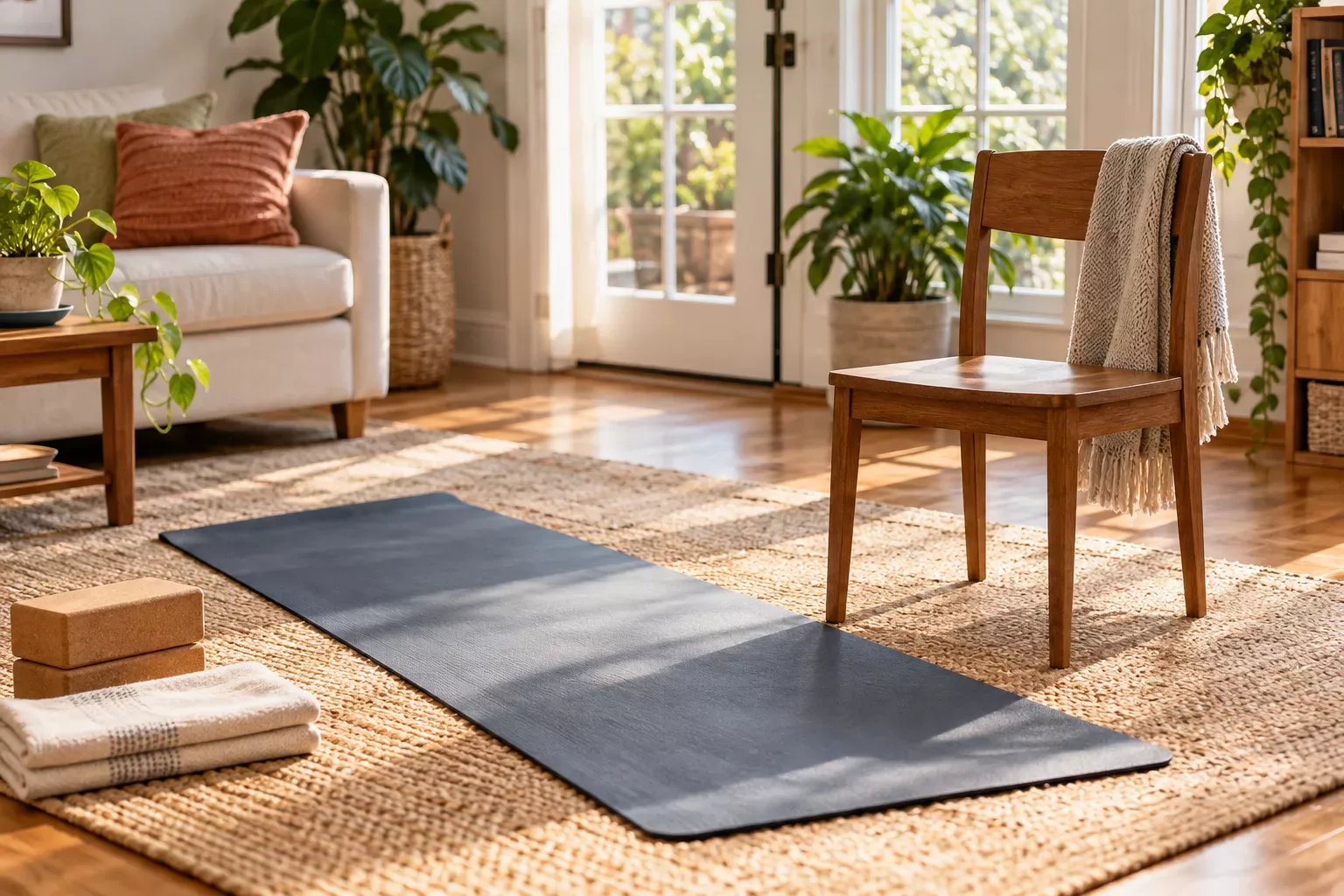
Understand what labels can and cannot tell you
Style names can describe traditions, teaching approaches, or marketing categories. Home-video platforms also use broad terms such as beginner flow or stretch and relax. Treat those as invitations to inspect the content. They are not standardized guarantees of difficulty, suitability, or the results you will experience.
NCCIH describes yoga as including many styles with different physical demands. For choosing a first class, the practical implication is simple: evaluate the actual lesson. NCCIH overview of yoga
Ask useful follow-up questions
If a class description says chair yoga, ask whether it is entirely seated or includes standing beside the chair. If it says restorative, check what support is used and how viewers are taught to arrange it. If it says fundamentals, find out whether the teacher explains transitions as well as positions. The clarifying question should turn an appealing label into information you can use.
You do not need to master the history of every style to select an introductory recording. At the same time, avoid assuming that a short exercise video represents the full scope of yoga. You can respect the broader practice while choosing a clearly defined movement lesson for your present needs.
Make a format shortlist
Compare two or three formats that plausibly fit your room and preferences. Do not test every option in a single week. A short shortlist gives you a way to explore without making each session a completely new coordination task.
| Desired experience | Feature to inspect | Question the label leaves open |
|---|---|---|
| Detailed introduction | Demonstrations with verbal setup | Are basic terms explained? |
| Mostly upright practice | Clearly standing-only sequence | Are balances included? |
| Seated session | Entire class stays seated | Is the chair setup appropriate? |
| Linked movement | Transitions taught before repetition | Is the pace suitable for learning? |
| Supported positions | Support arrangement demonstrated | Are equipment and positions suitable? |
Choose the row that reflects your needs today. It is fine if a different row fits next month. A format choice is a practical decision, not a ranking of how serious your yoga practice is.
Preview the less obvious demands
Look beyond the most photogenic position. A class may spend most of its time in simple shapes but include a difficult route down to the floor. Another may repeat a standing balance without explaining alternatives. The demand that matters most may appear in the transitions, the duration of holds, or the number of times you must change orientation.
Inspect how the teacher handles those moments. Is there time to set up? Is an alternative taught clearly? Can you remain in a comfortable position while observing? If you cannot identify a route that fits, remove the class from your shortlist rather than planning to guess your way through it.
Do not equate props with accessibility
A chair or other support can be part of instruction, but the presence of an object does not make a session universally suitable. The lesson still needs an appropriate setup and movements you understand. If you need an adaptation, learn how to use it rather than treating any household object as a substitute for guidance.
This applies equally to classes that use no equipment. No props may describe convenience, but it says little about balance, hand weight-bearing, kneeling, or transitions. Keep the actual physical requirements in your selection notes.
A hypothetical format experiment
Imagine Jordan wants to begin yoga in an apartment and initially assumes a class labeled slow flow will be the obvious choice. The preview shows clear instruction, but frequent floor changes do not fit Jordan's current preference. A second video called standing fundamentals stays upright and teaches a small number of positions. Jordan checks the room, then chooses the second lesson for a first trial.
Afterward, Jordan notes that standing instruction was easy to follow but the longer holds were more demanding than expected. For the next attempt, Jordan looks for a similar format with shorter holds rather than changing every feature. This fictional example shows how useful feedback can be more specific than liking or disliking an entire style.
Jordan might later enjoy linked movement or seated practice. The initial choice does not limit future exploration. It simply provides a manageable starting experience and a vocabulary for requesting something different.
Evaluate teaching compatibility after the trial
Ask whether you understood the teacher, could identify offered options, and had enough time to make choices. Also consider presentation preferences. Some people enjoy a conversational teacher; others prefer fewer words and more direct cues. Those preferences can affect whether you return, provided the essential instruction remains clear.
Keep one feature stable when trying a second class. You could compare two teachers using the same general format, or try a new format with a familiar teacher. Changing style, pace, duration, and instructor simultaneously makes it difficult to know which feature improved the experience.
There is no requirement to move from seated to standing, slow to fast, or simple to elaborate classes. Explore when it serves a purpose you can name. A class that continues to fit may remain useful long after you stop feeling completely new.
Continue learning
- How to Choose a Beginner Yoga Video You Can Actually Follow
- Can You Start Yoga If You're Not Flexible?
- Yoga vs. Stretching at Home: What Should a Beginner Choose?
Questions and answers
Is hatha always the easiest style for beginners?
The label alone cannot establish that. Teachers use it for classes with different pacing, positions, and assumed knowledge. Inspect an individual lesson for clear explanations and suitable transitions. An explicitly introductory class with practical details gives you more useful information than a broad style name by itself.
Can a beginner try vinyasa at home?
Look for a class that specifically teaches beginners and explains its linked movements. Preview the transitions and physical demands before deciding. A fast class that assumes familiarity may be a poor learning match, even when the poses look simple. Seek guidance when you cannot tell whether the sequence fits your needs.
Is chair yoga only for older adults?
A chair-based format can interest people for many practical reasons, including a preference to stay seated. Age is not enough to determine suitability. Check whether the lesson remains seated, whether the chair setup is explained, and whether the actual movements are appropriate for you.
Should I choose a style based on a health goal?
Avoid treating a style label as a treatment recommendation. If a condition or symptom is central to your choice, ask an appropriate healthcare professional and a suitably experienced instructor about your needs. General video descriptions cannot establish the right program or adaptations for an individual situation.
How many styles should I try before deciding?
There is no required number. Begin with one plausible format, assess the actual experience, and change a specific mismatch if needed. You can keep exploring gradually. Finding one class you understand and would repeat is a more useful first milestone than completing a survey of every label.
Does staying with basic classes mean I am not progressing?
Progress can include understanding instructions, choosing suitable options, and organizing a repeatable practice. It does not require increasingly dramatic shapes or faster sequences. If a basic class still serves your purpose, you can keep using it while asking an instructor about any learning questions that arise.