
Downward-facing dog appears in many yoga classes, but you do not have to make it the center of your home practice. You can choose a session that omits it and still learn other aspects of yoga.
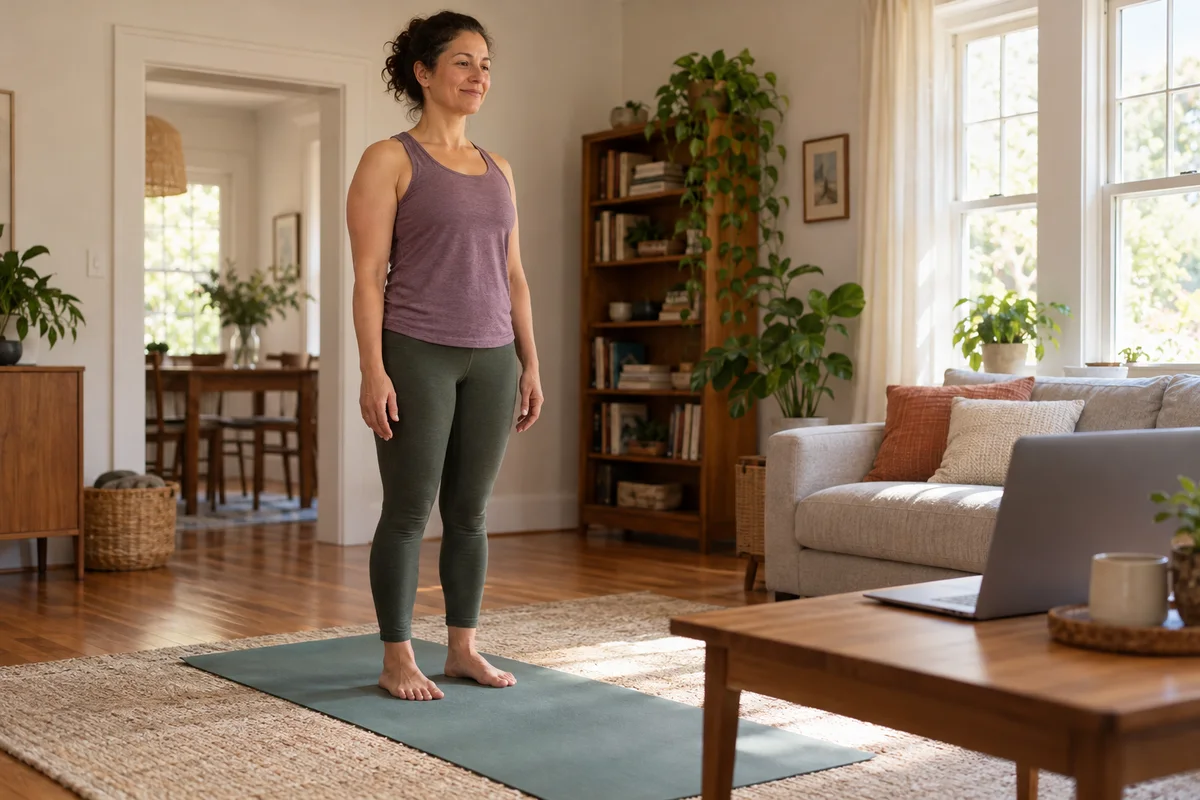
AI-generated editorial illustration: adult standing comfortably with arms relaxed during a home lesson.
First identify why you want to leave it out. A preference, difficulty understanding the position, hand-loading restriction, or symptom may lead to different class choices.
Choose omission before improvisation
If your goal is simply to avoid the pose, look for a class explicitly described as no downward dog. Preview the sequence to confirm that it does not appear in the warm-up or transitions.
You can also inspect standing or seated formats, but do not assume those labels exclude every version of the movement. Some classes use a chair-supported variation.
Recognize that substitutes do different jobs
There is no single replacement that preserves every demand of downward-facing dog for every person. A seated rest, an upright stance, and a forearm-supported position are not interchangeable.
If an instructor suggests an alternative, ask what it changes and how to enter it. Do not automatically substitute another inverted or weight-bearing position when your reason for avoiding the original involves symptoms or an injury.
Tell the teacher before a live class
Explain whether you want to rest when the class uses downward dog or follow a different movement. Ask for an option that works with the surrounding transitions.
A useful alternative must be practical to enter and leave. It should not require you to rush across the room or borrow unstable furniture to keep up with the flow.
Evaluate the entire session
A class without downward dog may still contain planks, deep bends, demanding balances, or frequent changes from standing to the floor. Avoiding one pose does not establish that the rest of the class suits you.
Read the description for the needs that matter to you: no hand weight-bearing, no kneeling, or remaining seated. Use those requirements when selecting a teacher or lesson.
Make repetition useful
When you find a suitable session, repeat it long enough to understand the cues. Notice what you enjoy and what you want help learning. You do not need to reintroduce downward dog on a fixed timeline to prove that you are progressing.
An instructor-created standing flow without downward dog or plank illustrates the kind of specific description to check. The session still needs to be evaluated for your own requirements.
Your home practice can reflect your choices and current needs. Leaving out a familiar pose is not the same as leaving yoga behind; it is a reason to choose instruction that fits more precisely.
Decide what omitting downward dog needs to accomplish
You may dislike the pose, find its instruction confusing, or need to avoid one of its demands. Begin with that reason rather than searching for a universal replacement. If the aim is simply to omit one position, a class designed without it may be enough. If you need no hand weight-bearing or no head-lowering positions, those broader requirements need checking throughout the sequence.
The distinction prevents a misleading substitution. A different hand-supported pose could still contain the feature you need to avoid. A chair version could still involve support through the hands. A standing rest could be practical in one class but awkward to enter during another. The relevant question is what fits your purpose and the surrounding instruction.
Write a selection sentence
Use a sentence you could send to an instructor: “I want a beginner class without downward dog, and I would like to remain standing throughout.” If you have another restriction, add it separately. This gives the teacher or your own preview process concrete criteria instead of asking whether a class is generally gentle.

AI-generated editorial illustration: beginner choosing a standing class on a tablet.
When symptoms or medical advice are involved, keep the boundaries clear. You can describe the restriction, but a class search should not become a way to diagnose why the pose feels difficult. Ask an appropriate professional to interpret the symptom or clarify the advice rather than trying successive substitutes until one seems less noticeable.
Look for the pose in transitions and variations
Some classes use downward-facing dog as a repeated transition rather than a long hold. It may appear between standing and floor sequences, after a warm-up, or as the default resting place. A pose list or short preview can miss those uses. Watch the beginning, middle, and finish before concluding that the class omits it.
Also inspect variations described by another name or supported by furniture. If your reason for omission involves a particular physical demand, check for that demand directly. The exact pose name is not the only useful search criterion. You are choosing what you will do, not just confirming that one phrase is absent from the title.
Read descriptions as questions to verify
“No downward dog” is a helpful starting description. “No downward dog or plank” adds another piece of information. “All standing” describes a format but can still include significant bending or balance. None of these phrases answers every question about pace, transitions, space, or other restrictions.
Save a note when you have checked the sequence. For example, “No downward dog; standing throughout; includes wide arm movements” captures useful information without claiming universal suitability. If wide arm movements do not fit your room, the class may be unsuitable for that opportunity even though it meets your main pose preference.
| Reason for leaving the pose out | What to inspect next | What not to assume |
|---|---|---|
| Personal preference | Whether the sequence remains understandable without it | That preference requires a medical justification |
| Confusing instruction | Whether another teacher explains the skill more clearly | That repetition alone will answer the question |
| No hand weight-bearing | All supported poses and transitions | That omitting downward dog removes every hand load |
| Avoiding floor transfers | Starting position, level changes, and finish | That one omitted pose means the class stays upright |
| A health-related restriction | Guidance specific to the restriction | That a generic online substitute is treatment |
Understand what different alternatives actually offer
An ordinary standing pause gives a place to stop moving. A seated rest changes the starting level. A teacher-led movement may explore another skill entirely. These options need not reproduce every aspect of downward dog to be useful, but it helps to understand their role. Are you resting, waiting for the next section, or learning another movement?
Avoid the idea that every omitted pose leaves a gap you must fill immediately. In a suitable lesson designed without downward dog, the teacher has organized the sequence around other positions. You can follow that organization rather than trying to add a substitute because familiar classes usually include the pose.
Make an alternative usable in real time
For a live class, ask when to begin the alternative, how long to remain, and how to rejoin. If everyone else returns from the floor while you remain standing, the next cue needs to make sense from where you are. A helpful alternative covers that route rather than offering only a position name.
Practice unfamiliar transitions only with appropriate instruction, outside the pressure of keeping up. Do not move a chair across the room or hurry through an unexplained floor transfer because the recording has already continued. Pausing is available, and choosing a more coherent class can be the better long-term solution.
Keep learning goals independent of one pose
A beginner lesson can teach how to follow cues, coordinate manageable movement, notice when to pause, and use appropriate options. None of those learning tasks requires downward dog to be the centerpiece. You can judge the class by whether its actual instruction supports your purpose, rather than by whether it contains the most recognizable yoga silhouette.
This approach also helps avoid an unnecessary deadline. You do not have to schedule the pose's return after a certain number of sessions. If you later want to learn it, seek instruction that explains its demands and appropriate options. If you continue choosing classes without it, that is a valid selection preference within your practice.
Use repetition to learn the class you chose
Once you find a suitable no-downward-dog session, repeat it if familiarity is useful. Notice whether the cues become clearer and whether transitions feel less hurried. These are practical observations about learning; they do not certify technique or prove a health benefit.
If you want variety, change one feature at a time. You might explore another beginner teacher while keeping the same entirely standing format. Preview each new lesson independently. A familiar label does not guarantee that its balance work, arm positions, or movement pace will resemble the class you already know.
A hypothetical class conversation
Imagine Lee wants to join a live home class but prefers to omit downward dog. Lee asks the instructor before class whether remaining upright during those sections would work and how to rejoin the next movement. The instructor explains a specific sequence option, or recommends a different class if the group format cannot accommodate the request clearly.
This invented example illustrates asking about sequence logistics rather than copying a generic substitute. It does not imply that the suggested upright option is appropriate for every person. The useful result is a clear plan or a better-fitting lesson, with no requirement to explain a personal preference to the entire group.
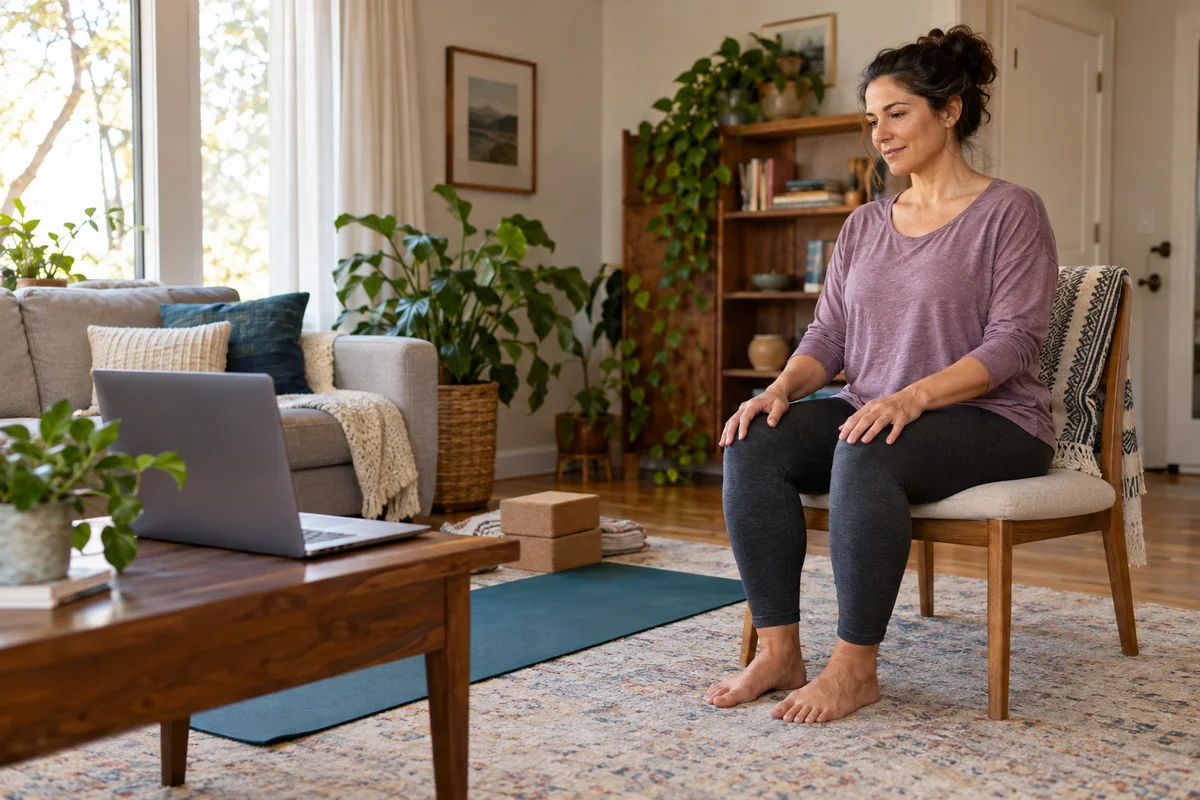
AI-generated editorial illustration: seated rest option beside a mat in a small living room.
Questions and answers
Is downward dog required for beginner yoga?
You can choose beginner instruction organized around other positions. Check that the class supports your learning goals and current needs. A pose's popularity does not make it a prerequisite for starting a home practice or a test you must pass before using a different format.
What is the best replacement for downward dog?
There is no single replacement for every purpose and person. First identify whether you want rest, a different movement, or avoidance of a specific demand. Then ask for an option that fits both your needs and the transitions before and after that section.
Does no downward dog mean no wrist loading?
No. A class may still include plank, tabletop, chair-supported positions, or hand-supported transitions. If you need no hand weight-bearing, use that exact requirement when evaluating the whole session rather than assuming that omitting one pose removes the demand everywhere.
Can I simply skip forward in the video?
You can pause or stop, but skipping forward may hide an important transition or explanation. Watch from rest first if needed, then resume only when you understand the next starting position. If frequent skipping is necessary, look for a class designed without the pose.
Should I eventually work toward doing it?
That is an optional learning goal, not a required milestone. Consider your preferences, current needs, and any relevant guidance. If you choose to learn the pose later, use appropriate instruction rather than imposing a calendar deadline based on how many other classes you completed.
What if my teacher says everyone rests in downward dog?
Explain that it is not an appropriate resting option for you and ask for a usable alternative with clear transitions. If the class cannot provide one, select another lesson. A resting instruction needs to fit the participant, rather than functioning as an obligation to use one familiar position.