
If you want a yoga session without putting body weight through your hands, look for a class that explicitly meets that requirement. “Gentle” and “beginner” do not necessarily mean wrist-free. Many introductory floor classes still include tabletop, plank, or downward-facing dog.
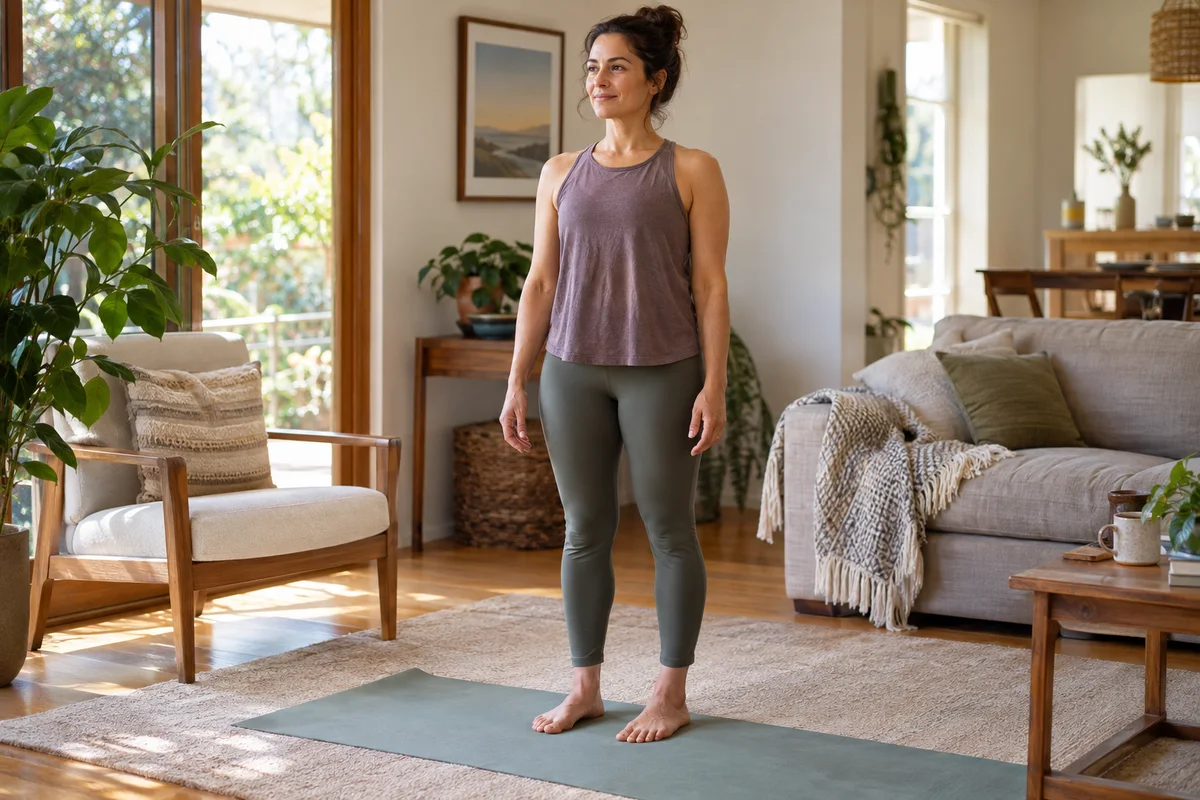
AI-generated editorial illustration: adult standing in a neutral comfortable stance with relaxed hands.
This guide is about choosing a practice, not treating wrist pain. If pain or an injury is driving your choice, get guidance about what movements are appropriate for you.
Define what you need to avoid
“Wrist-free” may mean no hand weight-bearing, but you should check how the teacher uses the term. Some sessions still include arm movements or positions involving the wrists without loading them.
Be specific when asking a teacher: “I need a practice without supporting my body on my hands” is clearer than “I need something easy.” Also mention any restrictions on the arms or shoulders if those affect the session.
Preview the whole class
Check the opening, middle, and transitions. A mostly standing class may still start with a floor warm-up. A session advertised as hands-free might include a movement you need to avoid for another reason.
Read the equipment list. Do not assume that placing your hands on a chair or blocks eliminates weight-bearing. Raised support changes the setup, but it does not automatically remove the demand you are trying to avoid.
Do not substitute automatically
Replacing a hand-supported position with a forearm-supported one is not a universal solution. It changes where and how you bear weight, and may introduce demands elsewhere.
Similarly, moving onto fists or buying a wedge does not make an unsuitable movement appropriate. Choose a purpose-designed class or get a teacher's help rather than converting every position yourself.
Consider standing or seated formats
A suitable standing session can avoid many floor transitions. A seated lesson may be another option. The actual movements still matter: standing balance, overhead arm positions, and twisting can have their own requirements.
Choose a format because it fits your needs, not because “no hands” sounds like a guarantee that the class will be effortless.
Prepare a clear stopping option
Before starting, decide how you will rest if an unexpected movement appears. You can stop and watch the next section without trying to improvise a substitute.
Keep one suitable class saved once you have found it. Note whether it avoids hand weight-bearing throughout or only in part, so you do not need to recheck from memory every time.
For an example of how teachers label the format, preview a hands-free class. Evaluate the actual session before using it; a category label alone cannot establish suitability.
The goal is an understandable practice with the constraints you need. You do not have to work around a wrist-loading flow when a different format may be a better starting point.
Translate wrist-free into a precise class requirement
The phrase wrist-free can describe several different choices. You might want no body weight through the hands, no sustained wrist position, or no active arm movement. Those are not equivalent. A class can avoid plank yet include hands pressing into a wall or chair. Another can avoid hand support while using repeated arm reaches that do not fit a separate shoulder restriction.
Write your requirement in ordinary language before searching. “I want to remain seated or standing without supporting myself on my hands” describes a class feature. If your restriction comes from medical advice, use that advice accurately and ask for clarification when the permitted activities are unclear. This article helps with selection; it cannot determine which movements an injury allows.
Distinguish contact from support
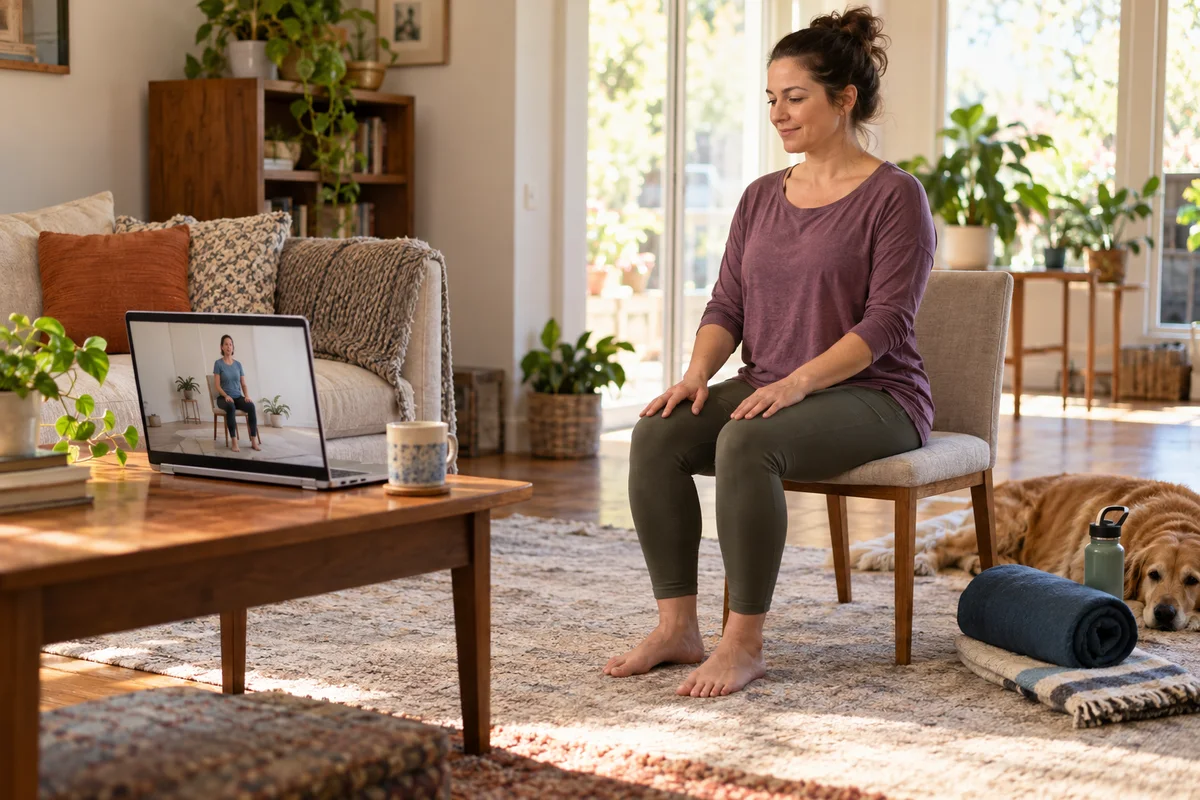
AI-generated editorial illustration: beginner reviewing a hands-free class on a laptop.
Resting a hand comfortably on a thigh is different from pressing through the hand to hold up part of your body. However, you should not assume any contact is acceptable when your restriction is broader than avoiding weight-bearing. A teacher needs to know whether the issue involves support, range, gripping, arm position, or another specific limitation.
Descriptions such as “wrist friendly” leave room for interpretation. Ask what the teacher actually excludes. Does the class remove all hand-supported poses? Does it change only their duration? Does it provide a version on raised support? The answers are more useful than the reassuring adjective used in the title.
Inspect the hidden loading moments
A class may have no obvious hand-supported holds but still ask you to push off the floor to stand, place hands behind you while sitting, or lean on a chair during a transition. These moments are easy to miss when you preview only the central sequence. Watch how the teacher begins, changes levels, rests, and finishes.
Transitions deserve the same attention as named poses. If your aim is no hand weight-bearing throughout, a single required push from the floor may make the class unsuitable. Selecting an entirely seated or standing lesson can simplify the search, but it remains necessary to check whether the session uses walls, furniture, or the hands for support.
Use a full-sequence checklist
Make four short notes: opening position, support used, level changes, and finish. You can add timestamps if a section needs clarification. This creates a practical record without requiring detailed knowledge of every yoga term. If the teacher's hands are outside the camera view during an important transition, treat the requirement as unresolved.
Avoid relying on comments from other viewers who say a class worked for their wrists. They may mean something different by wrist-free, have different restrictions, or have skipped sections without saying so. Use audience comments as context at most; verify the sequence and your own requirements independently.
| Class feature | What to check | Why the label is insufficient |
|---|---|---|
| Standing warm-up | Whether hands press into a wall or chair | Standing can still involve hand support |
| Seated floor section | Whether hands help enter or leave | A seated pose may hide a loaded transition |
| Forearm alternative | Whether it is actually appropriate for you | Moving the support does not establish suitability |
| Chair-supported variation | Whether body weight passes through the hands | Raising the support does not eliminate loading |
| Resting option | Whether you can reach it without hand support | A usable rest includes the route into it |
Select a format before selecting substitutions
If many movements require changing, choosing another class is often simpler than creating a parallel sequence. An all-standing lesson with appropriate balance demands may remove several floor transitions. An entirely seated lesson may do the same. Neither format is automatically suitable, but each can reduce the number of requirements you need to assess.
The aim is coherent instruction. You should know what you are doing while the class performs another movement, how long to remain there, and how to continue afterward. A succession of improvised replacements can make a beginner session harder to follow even when each replacement looks simpler in isolation.
Avoid the automatic forearm swap
Changing a hand-supported position into a forearm-supported position changes the task. It may alter shoulder demands, the position of the torso, and the route into and out of the movement. It is not a universal wrist-free solution. The same caution applies to making fists, gripping handles, or changing the angle with an object.
When a teacher proposes a modification, ask what requirement it addresses and whether it fits your restriction. You do not need to understand the full biomechanics to ask a practical question: “Does this still ask me to support my body through this arm?” Clear answers are more useful than assuming that a prop removes the relevant demand.
Keep other selection criteria active
Once you find a class without hand weight-bearing, check its remaining requirements. It may contain single-leg balances, deep bending, overhead arm positions, or frequent standing transitions. Avoiding hand support answers one question. It does not settle whether the pace, space, or other movements are appropriate for your home practice.
Keep the learning goal modest. You can use a suitable lesson to understand standing positions, ordinary breathing cues, and unhurried movement without treating it as a temporary workaround. You are not required to work toward plank or downward-facing dog before your practice counts as meaningful participation.
A hypothetical selection example
Imagine Morgan needs a session without hand weight-bearing. A video titled “gentle wrists” includes a chair version of a forward-supported position, which still asks the hands to help support the body. Morgan does not assume that using a chair makes it fit. Morgan instead checks an explicitly hands-free standing class and reviews its balance requirements before choosing it.
This invented example illustrates how to read a description, not how to manage a wrist condition. It does not establish that the second class is appropriate for every viewer. Morgan's useful decision is verifying the actual requirement rather than treating a softer title or raised surface as a guarantee.
Save a note that will still make sense later
Once a session fits, record what you checked: “Entirely seated; no pushing from floor; hands can rest; no required gripping.” If a teacher later releases a similarly named class, evaluate it independently. A familiar series title does not ensure identical requirements across every lesson.
Review the note if your needs change. A class that meets a preference may not meet a new medical restriction, and a restriction involving one hand may not be addressed by a generic hands-free description. Keeping the language specific helps you ask useful questions without turning every future selection into a new search from scratch.
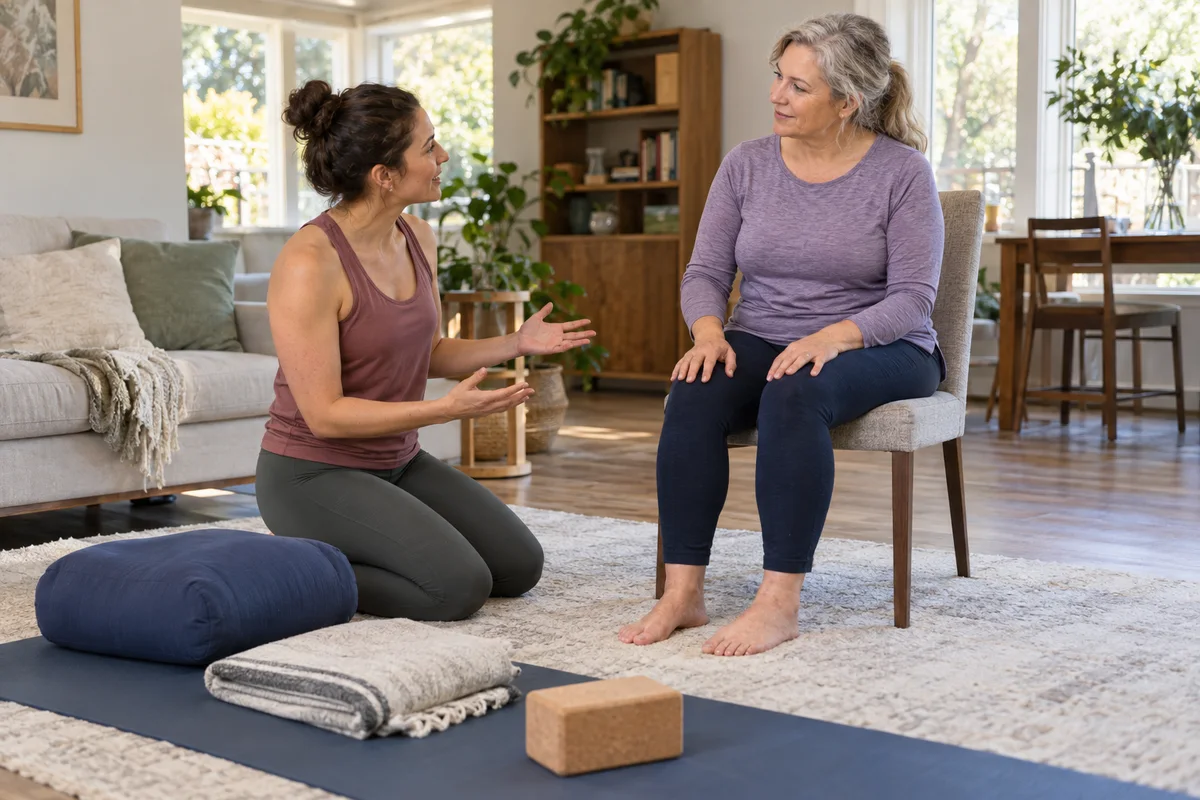
AI-generated editorial illustration: instructor discussing options with a beginner without touching.
Questions and answers
Does wrist-free mean no hand movement at all?
Not necessarily. Teachers use the phrase differently, so inspect the actual session. If you need no hand weight-bearing, say that explicitly. If gripping, wrist movement, or arm position also matters, describe those restrictions separately rather than assuming the class label covers them.
Is wall yoga automatically wrist-free?
No. Some wall-based movements ask you to press through the hands and support part of your body. Check how the wall is used throughout the class. A higher support changes the arrangement but does not automatically eliminate the loading you intend to avoid.
Can I replace every plank with a standing rest?
An upright rest may be an option in a particular sequence, but the transition and surrounding movements still need to make sense. Ask the teacher how to enter, remain, and rejoin. If constant substitutions are needed, a class designed around your requirement may be clearer.
Are fists or forearms a safe answer for wrist pain?
This article cannot determine that. Changing the contact point changes the exercise and may introduce other demands. If pain drives your choice, get individual guidance rather than using a generic substitution as treatment or assuming it makes an unsuitable movement appropriate.
Can a beginner learn yoga without supporting weight on the hands?
You can look for instruction organized around other positions and skills, including appropriate seated or standing formats. Evaluate the actual lesson and your other needs. Hand-supported poses are not a prerequisite for choosing a coherent beginner practice that fits your current requirements.
What should I do if an unexpected hand-supported movement appears?
Pause before attempting it. Rest in a position already appropriate for you, watch the next section, and decide whether the class still fits. Do not hurry to invent a replacement. Save the timestamp if you want an instructor to clarify an alternative later.