
You can search for a yoga practice that avoids kneeling rather than trying to pad or tolerate every floor position in a general class. Start by identifying whether you need to avoid direct knee contact, floor transitions, deep knee bending, or more than one of these.
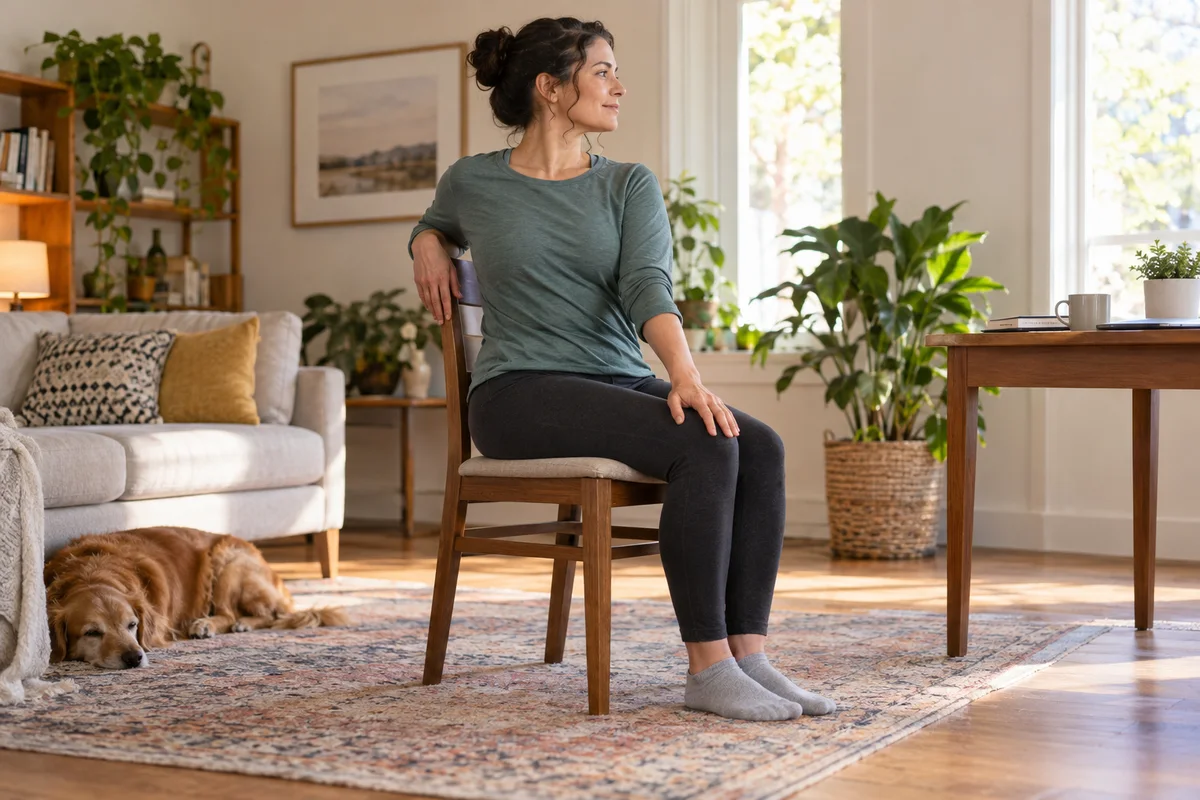
AI-generated editorial illustration: adult seated upright on a stable four-legged chair without wheels.
Those are different requirements. A no-kneeling class does not automatically avoid all knee demands, and it is not a rehabilitation program.
Describe the restriction clearly
If you are asking a teacher for help, explain what you need: “I cannot put my knees on the floor” or “I need to remain standing or seated throughout.” This makes it easier to discuss an appropriate class.
If the restriction comes from an injury, surgery, or medical advice, share the relevant guidance with the instructor. Do not replace it with a generic online modification.
Check transitions as well as poses
A class can contain no prolonged kneeling holds but still ask you to lower a knee during transitions. Preview how the session starts, changes levels, and finishes.
Look for explicit descriptions such as all-standing or entirely seated, then verify the video. If you do not have a reliable way to get down to and up from the floor, choose a practice that does not require doing so.
Do not assume standing means easy
Standing sessions can include deep bends, lunges, and balances. These may be unsuitable even though the knees never touch the ground.
Choose a class with clear options and an appropriate pace. Keep a stable support nearby only when the teacher explains how to use it safely; a rolling office chair is not a dependable balance support.
Treat cushioning as an option, not an obligation
A cushion may change contact with the floor, but it does not resolve every reason someone avoids kneeling. You do not need to try a thicker pad before you are allowed to choose a different practice.
If a class repeatedly offers kneeling as its only resting position, find a teacher who provides a usable seated or standing alternative. Your resting option should be available when you need it.
Save the version that fits
Once you find a suitable session, record what it includes. For example: “entirely seated, no floor transitions” is more useful than “gentle class.” Keep the note with the link.
If a movement produces pain or feels uncontrolled, stop rather than finishing because the class was advertised as knee-friendly. Get individual advice when symptoms or restrictions need interpretation.
A practice without kneeling can be a deliberate choice. The aim is to find a class that respects your actual needs, not to recreate every part of a floor-based sequence by another route.
Define the exact meaning of no kneeling
Avoiding knees on the floor is a clear requirement, but it may be only part of what you need. You may also want to avoid getting down to the floor, deep knee bending, or a transition that briefly brings one knee down. Write these requirements separately so a class description can be checked against each one.
A teacher can respond more precisely to “I need to stay seated in a chair for the entire session” than to “I need something gentle for my knees.” The first sentence identifies a format. The second leaves open questions about floor contact, range, balance, and the reason for the request. When medical guidance applies, do not replace its specific restrictions with a general class adjective.
Keep floor contact separate from knee movement
A standing lesson can avoid kneeling while still including lunges, repeated bends, or single-leg work. A seated lesson can also involve substantial knee movement. No-kneeling describes the absence of one type of contact; it does not certify that every other demand is suitable for a particular person.
AI-generated editorial illustration: beginner standing beside a mat with no kneeling.
This distinction matters when searching. If the issue is simply a preference not to kneel, you can select accordingly. If an injury or condition limits particular movements, those limits need their own interpretation. A written guide cannot determine the permitted range or identify a movement as treatment based only on where the knee touches the floor.
Preview the routes between positions
Watch the transitions even when the list of poses appears suitable. A lesson might move from standing into a seated floor position by lowering onto one knee. It might finish by asking you to roll onto hands and knees before standing. Neither moment may appear in the title or written list, yet both matter for an entirely no-kneeling practice.
Check how the teacher instructs rest as well. If kneeling is offered whenever the class pauses, you need another appropriate option that you already understand. A rest is useful only if you can enter it and leave it without encountering the very requirement you are trying to avoid.
Make a beginning-to-end map
Use plain descriptions: “starts standing, stays standing, finishes standing” or “starts seated in a chair and remains seated.” If the class changes levels, note how. You do not need to memorize every pose name to identify an unclear floor transfer.
If the video skips the transition through editing or cuts to another camera view, do not assume the missing part is simple. Seek clarification or choose a format without the unresolved transfer. Selecting an uninterrupted, clearly demonstrated lesson can be more practical than trying to fill in omitted steps on your own.
| Your actual requirement | Useful description to look for | Remaining checks |
|---|---|---|
| No direct knee-floor contact | Explicitly no kneeling | Brief transitions and resting positions |
| No floor transfers | Entirely seated or entirely standing | How the class begins and ends |
| Limited knee bending | Specific options discussed with an appropriate professional | Actual range and repeated movements |
| No standing balance work | Entirely seated format | Chair stability and seated demands |
| Several restrictions together | A class or individual lesson addressing all of them | Whether alternatives form a coherent sequence |
Choose a deliberate format rather than endless padding
Padding can change the feel of contact, but it does not answer every reason someone avoids kneeling. You do not have to keep adding layers before choosing a different format. If the requirement is no kneeling, a class organized without it may be easier to follow than repeatedly arranging and removing cushions.
Similarly, a blanket does not explain how to get to the floor, establish that deep bending is appropriate, or resolve a symptom. Keep props in their proper role: they can be part of instruction when suitable, but they do not turn a general class into individualized care. Ask what the prop is intended to change before assuming it addresses your need.
Compare seated and standing options honestly
An entirely seated class may simplify floor-transfer concerns, but chair setup still matters. A standing class can keep the knees away from the floor while introducing balance demands or a larger space requirement. Select the format according to the complete lesson and your situation, rather than ranking one as universally easier.
Read whether a “chair yoga” class remains seated or uses the chair as support for standing movements. Those formats are different. If remaining seated is essential, confirm it throughout. Do not wait until halfway through a work break or home lesson to discover that the second half takes place around the chair.
Ask for adaptations as a sequence question
If you want to join a live class, tell the teacher your requirement before it begins. Ask how the class handles the sections where other participants kneel and how you would continue afterward. A useful answer should cover the position, its duration, and the route to the next part of the class.
If the proposed option needs furniture, clarify the furniture requirements. A nearby chair is not automatically an appropriate support, especially if it rolls, swivels, or shifts. Do not substitute a movable object because it happens to be convenient. If the required setup is unavailable, choose another format for that opportunity.
Know when the class requires too much rebuilding
If every few minutes you need an entirely different route, the class may be a poor match even if individual alternatives exist. Following a second sequence while listening to instructions for the first can be confusing. A lesson designed around your needs may allow more attention to learning and less attention to improvisation.
Choosing that lesson is a positive format decision. You do not need to frame it as a temporary concession or promise that you will resume kneeling by a particular date. Any later change should follow your actual preferences and relevant guidance, rather than a generic idea of what a complete practice must contain.
A hypothetical no-floor choice
Imagine Elena wants a home session without kneeling or floor transfers. A class labeled no-kneeling includes a seated floor section but does not explain how to reach it. Elena marks the transfer as unresolved instead of assuming that she can work it out during the video. She then previews an entirely seated chair lesson and checks its remaining requirements.
The example is invented to show a selection process. It does not establish that chair yoga is appropriate for Elena's health or for every reader. Its purpose is to distinguish a label that meets one requirement from a complete session that meets the full set of practical needs.

AI-generated editorial illustration: clear standing-practice area with comfortable flat shoes nearby.
Questions and answers
Does no kneeling mean knee-friendly?
It means only what the teacher actually excludes, and even that should be verified. A session can avoid knee-floor contact while including demanding bends or balances. If a health restriction is involved, clarify the permitted movements with an appropriate professional rather than relying on a reassuring category name.
Should I try a thicker cushion first?
Only if cushioning addresses your actual preference or need and the movement is otherwise appropriate. You are free to choose a class without kneeling. More padding does not solve all floor-transfer, movement-range, or symptom concerns, and it should not be treated as a required first step.
Can I remain standing when the video kneels?
That depends on the surrounding sequence and whether the alternative is already appropriate for you. Ask how to continue and rejoin without rushing. If the recording repeatedly needs redesigning, an entirely standing or seated lesson may provide clearer instruction.
What if the class kneels only for a few seconds?
Duration does not erase the requirement. If you need no kneeling, a brief knee-down transition still matters. Preview those moments and select accordingly rather than assuming a short exposure falls outside your restriction or that you must attempt it to keep pace.
Is standing yoga always the best alternative?
No single alternative fits everyone. Standing practice may include balance work, deep bends, or other requirements that do not suit you. Evaluate the whole lesson, and consider a seated format when remaining seated meets your actual needs more accurately.
What should I save with a suitable video?
Record the features you verified: no knee-floor contact, no floor transfers, entirely seated, or another precise description. Add any unresolved questions. These notes help you repeat a suitable class and avoid treating every similarly named video as if it has identical requirements.